

Structural and Sagging Roof Repair Services

Structural and Sagging Roof Repair

In Helper and throughout Carbon County, where heavy winter snow loads, seasonal freeze-thaw cycling, and aging housing stock converge, structural roof damage is a more common issue than many homeowners realize.

Shep’s Roofing provides comprehensive structural and sagging roof repair for homes and businesses across Utah. Our approach goes beyond surface-level fixes, we identify the root cause of the structural failure, restore the load-bearing capacity of the affected components, and address the underlying conditions that allowed the damage to develop. Whether your roofline shows a visible dip, your attic framing has visible cracking, or a home inspector flagged structural concerns during a sale, our team has the expertise to diagnose the problem accurately and repair it permanently.

What Causes a Roof to Sag in Utah?

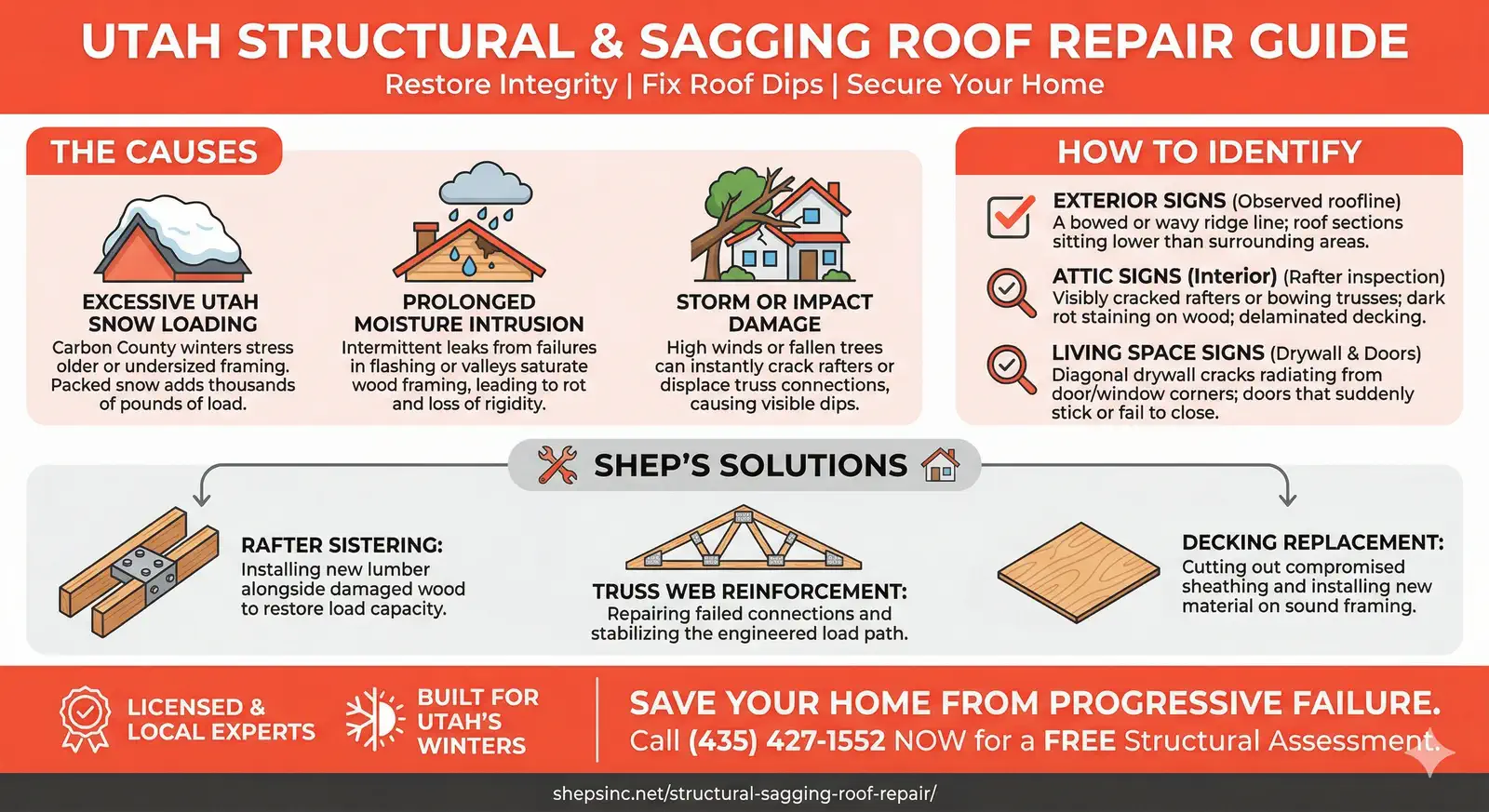
Structural sagging develops gradually as one or more load-bearing components lose their capacity to support the weight of the roof system. Understanding the causes helps homeowners recognize risk factors early and act before the problem becomes severe.

Prolonged Moisture Intrusion

The most common cause of structural sagging in the Helper area. Slow, intermittent leaks, originating at flashing failures, pipe boot cracks, or valley defects, saturate wood framing over months or years. Wet wood loses structural rigidity, and prolonged exposure leads to rot that can compromise entire rafters or decking sections. Because moisture concentrates in specific zones, localized weak points develop where the framing can no longer carry its share of the load and the roofline begins to deflect. Accurate roof leak detection is critical for catching these situations before they progress to structural failure.

Excessive Snow Loading

The second leading cause, and particularly relevant in Carbon County. Helper sits at approximately 5,800 feet of elevation and receives significant snowfall during multi-day winter storm systems. According to the International Code Council (ICC), residential roof structures in Utah’s mountain and high-valley zones must be engineered to support ground snow loads ranging from 30 to over 100 pounds per square foot depending on location and elevation. Older homes built before modern snow load standards were adopted may have framing that is undersized for the actual loads they experience, and a single severe winter can push these structures past their limits.

Inadequate Original Construction

Some homes, particularly older properties in Helper’s historic downtown and surrounding rural areas, were built with framing that does not meet current building code requirements. Undersized rafters, insufficient bracing, missing collar ties, and spans that exceed lumber’s structural capacity all contribute to gradual deflection under normal loading conditions. The sagging may have been developing slowly for decades, becoming noticeable only after years of cumulative stress.

Age-Related Material Degradation

Even properly constructed framing loses strength over time as wood dries, develops micro-cracks, and becomes more brittle. Homes that are 40, 50, or 60 years old may have framing that was adequate when installed but has since lost enough capacity to begin deflecting under loads it once handled comfortably.

Impact Damage From Fallen Trees or Debris

A large branch falling during a summer thunderstorm can crack rafters, displace truss connections, and crush sections of decking, producing immediate and visible sagging in the affected area. These events typically require an emergency roofing response to stabilize the damage before permanent structural repair can begin.

How to Identify Structural Sagging in Utah

Some signs of structural sagging are immediately obvious, while others require a trained eye to detect. Knowing what to look for, both inside and outside your home, allows you to act before a manageable repair becomes a major reconstruction project.

From the Exterior:

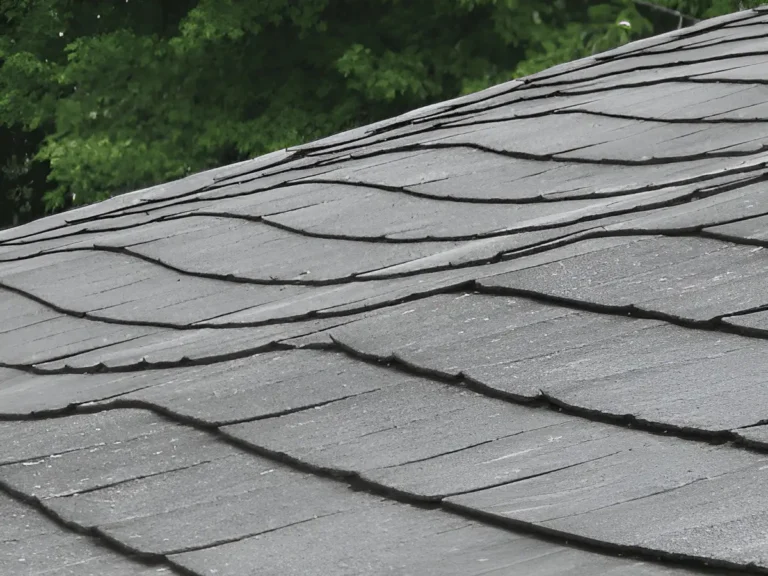
  • Observe the roofline from a distance — A healthy roofline should be straight and level along the ridge with a consistent slope from ridge to eave. Any visible dip, bow, or wave in the ridge line is a warning sign.
  • Look for sections sitting lower than adjacent areas — One portion of the roof appearing lower than surrounding sections indicates structural deflection in that zone.
  • Focus on high-risk areas — Pay particular attention to the midspan of long ridge runs and at points where additions or dormers connect to the original structure,  these are the most vulnerable to deflection.

From Inside the Attic:

  • Inspect rafters and trusses for stress signs — Cracking along the grain, visible bowing between supports, and separation at connection points where rafters meet the ridge board or truss webs meet the chords all indicate excessive load.
  • Check for rot and moisture damage — Dark staining, soft spots, and areas where a screwdriver can be pushed into the wood with little resistance confirm moisture-related rot in the framing.
  • Assess the roof decking condition — Warped, delaminated, or spongy plywood or OSB sheathing has lost its structural contribution and requires replacement.

From Inside the Living Space:

  • Watch for drywall or plaster cracks — Diagonal cracks radiating from the corners of door and window frames indicate the roof structure is shifting and transferring stress to the walls below.
  • Notice sticking doors and windows — Doors or windows that suddenly become difficult to open or close may be responding to frame distortion caused by a sagging roof structure.
  • Look for ceiling separation or bowing — Ceiling panels that have separated from the wall line or show a visible bow suggest ceiling joists are deflecting under roof loads being transferred through the framing.

If you notice any of these signs, schedule a professional roof inspection immediately. Structural issues do not stabilize on their own,  they worsen progressively under continued loading, and repair scope and cost increase with every season of delay.

Structural Roof Repair Techniques: What Each Method Fixes and When It’s Used

Not all structural repairs use the same technique, the right approach depends on which component has failed and the extent of the damage. This table outlines the primary repair methods Shep’s Roofing employs for structural and sagging roof repairs across Helper and Carbon County.

Repair Technique

Component Addressed

When It’s Used

What It Restores

Rafter sistering

Damaged, rotted, or cracked rafters

Localized rafter failure from moisture or overloading

Full load-bearing capacity at affected rafter position

Truss web reinforcement

Failed truss web members or chord connections

Truss connection separation or web member cracking

Engineered load path and truss structural integrity

Connection plate installation

Truss-to-wall or rafter-to-ridge connections

Separation at structural connection points

Load transfer integrity at joint

Decking replacement

Rotted, delaminated, or spongy OSB/plywood sheathing

Moisture damage or structural compression of decking

Structural contribution of roof deck to overall system

Ridge beam reinforcement

Sagging or cracked ridge board or ridge beam

Midspan deflection of ridge under rafter load

Lateral support and roofline alignment

Collar tie installation

Missing or undersized collar ties between opposing rafters

Rafter spread under load, wall-top distortion

Resistance to outward thrust on exterior walls

Leak source elimination

Flashing, pipe boots, valleys causing moisture intrusion

Any structural repair caused by water damage

Prevention of recurring moisture damage to repaired framing

Full structural rebuild

Entire framing system

Widespread rot, multiple truss failures, pervasive deterioration

Complete new framing with full-length warranty

Our Structural Roof Repair Process for Utah Properties

Shep’s Roofing follows a systematic approach to structural sagging repair that prioritizes accurate diagnosis, targeted intervention, and long-term stability, not temporary fixes.

  • Step 1: Comprehensive Structural Assessment — Our technician inspects the full roof system from the attic, examining every rafter, truss, and section of decking in the affected area. We measure the extent of deflection, identify which specific components have failed, and determine the root cause, whether moisture damage, snow overloading, inadequate original framing, or a combination of factors. Everything is documented with photographs and measurements before any repair discussion begins.
  • Step 2: Tailored Repair Plan — Based on the assessment, we develop a repair plan specific to your roof’s conditions. No two structural failures are identical, and our approach reflects the actual findings, not a one-size-fits-all solution.
  • Step 3: Rafter Sistering — For rafters weakened by rot or cracking, we install new lumber of equal or greater dimension alongside the damaged rafter and bolt the two together. This restores full load-bearing capacity at that rafter position without requiring removal of the damaged member, which would otherwise necessitate stripping the roofing material above.
  • Step 4: Truss Reinforcement — For trusses with failed web members or broken connections, we fabricate and install reinforcement plates or replacement web members to restore the truss’s engineered load path and return it to design capacity.
  • Step 5: Decking Replacement — Delaminated, rotted, or structurally compromised plywood or OSB sheathing is cut out and replaced with new sheathing of equivalent thickness and grade. We extend the replacement area beyond visible damage to ensure new decking is fastened to sound framing on all edges.
  • Step 6: Leak Source Elimination — If moisture intrusion caused the sagging, we address the water source as part of the same repair scope. Restoring structural integrity without fixing the underlying leak would allow the same damage to recur. This may involve flashing replacement, pipe boot repair, valley restoration, or other targeted roof repair work completed in conjunction with the structural fix.
  • Step 7: Code Compliance Verification & Roof Restoration — Once structural repairs are complete, we verify that the repaired section meets Utah building code requirements for load capacity and that the roofline has been restored to correct alignment. We then reinstall all roofing material disturbed during the repair, shingles, underlayment, and flashing, returning the roof to full weathertight condition.

Why Choose Shep’s Roofing

  • Structural Diagnosis First, Repair Second — We never start cutting or sistering until we fully understand what failed and why. Our assessment identifies the root cause, moisture, overloading, or inadequate framing, so the repair addresses the problem permanently, not just the symptom.
  • Carbon County Snow Load Expertise — We understand exactly what Helper’s elevation and winter storm patterns do to residential framing. That local knowledge informs every structural repair we plan, from rafter sizing to decking replacement specifications.
  • Code-Compliant Repairs, Every Time — Every structural repair we perform is brought into full compliance with current Utah building codes for load capacity and framing standards, not just patched back to its previous condition.
  • We Fix the Leak That Caused the Damage — If moisture intrusion drove the structural failure, we eliminate the water source as part of the same project. A structural repair without addressing the leak is not a repair, it is a delay.
  • Honest Repair vs. Replacement Guidance — If targeted repair is the right call, we recommend it. If widespread damage makes full replacement the smarter investment, we tell you that too, with a clear cost comparison so you decide with full information.
  • No Subcontractors — Structural repairs require consistent, accountable craftsmanship. Our own licensed crew handles every phase of the work from assessment through final weatherproofing.

When Repair Is Not Enough: Knowing When Replacement Makes Sense

Not every sagging roof can be cost-effectively repaired. In some cases, structural damage is widespread enough that piece-by-piece repair would cost more than removing the roof system and rebuilding it correctly from the ground up.

Repair Is Almost Always the Right Choice When:

  • Structural damage is confined to a localized area, two or three rafters, a single truss, or an isolated decking section
  • The repair restores full structural capacity at a fraction of replacement cost
  • The majority of existing roofing material can remain undisturbed during the fix

Replacement May Be the Better Investment When:

  • Assessment reveals widespread rot affecting a large percentage of the framing
  • Multiple truss failures are present across different roof zones
  • Pervasive decking deterioration exists across most of the roof surface
  • The cumulative cost of repairing each individual component approaches or exceeds the cost of a complete teardown and rebuild

What full replacement offers in severe cases — A complete teardown and structural rebuild delivers a fully new framing system with a full-length warranty, rather than a patchwork of old and new lumber that may require additional attention in the years ahead.

Our team will always give you an honest recommendation. If repair is the right call, we will explain why and provide an itemized estimate. If roof replacement makes more financial sense, we will walk you through the comparison so you can make an informed decision. We can handle either path, from targeted structural repair to a complete roof installation built on new framing. For homeowners who want a second opinion before committing to either direction, we encourage you to visit our about page or read our customer testimonials to understand how we approach every project.

Snow Load, Ice Dams, and Structural Risk in Carbon County

Carbon County’s elevation and winter climate create structural loading conditions that most Utah homeowners never face. Here is what you need to know to protect your roof through the winter season.

  • Snow accumulation loads are significant — The National Weather Service in Salt Lake City regularly issues winter storm warnings for Carbon County with single-storm accumulations of 12 to 24 inches or more. Packed snow weighs 15 to 25 pounds per cubic foot; a two-foot accumulation across a typical residential roof can add 6,000 to 10,000 pounds of total load to the structure.
  • Older homes are at elevated risk — Homes in Helper’s historic core and surrounding rural areas may have been built before modern snow load engineering standards were adopted. These structures are at heightened risk for sagging, deflection, and failure during heavy snow years.
  • Ice dams create a dual threat — When warm attic air melts snow on the upper roof and the water refreezes at the colder eaves, the resulting ice dam adds concentrated weight along the eave line while simultaneously forcing meltwater back under the shingles, overloading the structure and accelerating rot in the same framing members already under maximum stress.
  • Proper attic insulation and ventilation are the long-term solution — Eliminating the temperature differential that drives ice dam formation is the most effective and cost-efficient defense available to Utah homeowners.
  • Act before winter, not after — If you suspect your home’s framing may be undersized for Carbon County’s snow loads, schedule a structural assessment before the season begins. Proactive reinforcement costs a fraction of repairing a failure after the fact.

Testimonials

What They’re Saying About Us

***REVIEWS GO HERE***

Insurance and Structural Roof Damage

Homeowner’s insurance coverage for structural roof damage depends on the cause. Damage resulting from a sudden covered event, a tree falling on the roof during a storm, a collapse caused by an unusually heavy snow season that exceeded the structure’s rated capacity, or structural compromise following wind or hail damage, is typically covered under standard policies. Damage resulting from long-term neglect, deferred maintenance, or gradual deterioration is generally excluded.

Shep’s Roofing provides thorough documentation to support insurance claims involving structural damage. Our assessment reports include timestamped photographs, measurements of deflection, identification of the cause, and a detailed repair estimate formatted to insurance industry standards. We are available to meet with your adjuster on-site and walk through the findings. Having professional documentation from a licensed contractor strengthens your claim and helps ensure that the scope of covered damage is accurately represented.

Maintaining records of regular roof inspections demonstrates to your insurer that the roof was properly maintained, which supports the argument that structural damage resulted from a covered event rather than neglect. If you have experienced storm damage that may have compromised your roof’s structure, contact us promptly,  timely documentation is critical for claim processing.

Proudly Serving Utah With Expert Structural & Sagging Roof Repair Services

A sagging roofline is one of the most serious issues a Utah home can face, and one that demands a contractor with the structural knowledge to fix it correctly the first time. Shep’s Roofing delivers comprehensive structural and sagging roof repair services from our home base in Helper, UT, extending across Carbon County and throughout the state. 

Our service areas include Salt Lake City, Provo, West Valley City, West Jordan, St. George, Lehi, Orem, Sandy, Eagle Mountain, Herriman, and Saratoga Springs. Explore our complete list of coverage zones on our Service Areas page. From rafter sistering and decking replacement to full structural rebuilds following snow load damage or prolonged moisture intrusion, we restore your roof’s load-bearing integrity and bring it back into full building code compliance.

Schedule Your Free Structural Roof Assessment Today

A sagging roofline does not correct itself, and every season of delay increases the scope and cost of the eventual repair. Shep’s Roofing offers free structural assessments with detailed findings, clear explanations, and written repair estimates. Our experienced technicians will examine your roof’s framing, identify every issue, and present a straightforward plan to restore your roof’s structural integrity and protect your home for decades to come.

Call (435) 427-1552 or request your free estimate online to schedule your assessment. Priority scheduling is available for homes with active sagging, visible deflection, or recent storm damage.

Frequently Asked Questions

How serious is a sagging roof in Utah?

A sagging roof is a serious structural issue that requires prompt professional attention. It indicates that the load-bearing components,  rafters, trusses, or decking, have been weakened and can no longer fully support the roof’s weight. Without repair, sagging worsens progressively and can eventually lead to partial or complete roof failure. If you notice a visible dip in your roofline, contact us for a free assessment.

The most common causes of mid-ridge sagging are an undersized or damaged ridge beam, rafters that have cracked or rotted at their midspan, and excessive snow or ice loading that exceeds the structure’s design capacity. In Helper and Carbon County, where winter snow accumulation is significant, overloading during heavy snow years is a frequent contributing factor,  especially in older homes built before modern snow load standards were adopted.

In most cases, yes. If the damage is localized, affecting a limited number of rafters, a section of decking, or a single truss zone, targeted repair techniques like sistering, decking replacement, and connection reinforcement can restore full structural capacity without removing the entire roof. We evaluate every case individually and will recommend replacement only when it is the more cost-effective long-term option.

Costs vary widely depending on the extent of the damage. Localized repairs involving sistering two or three rafters and replacing a section of decking typically range from $1,000 to $4,000. Extensive structural repair involving multiple trusses, widespread decking replacement, and associated roofing material restoration can range from $5,000 to $15,000 or more. We provide a detailed written estimate after our assessment.

Coverage depends on the cause. Damage from a sudden covered event, a severe snow season, storm impact, or fallen tree, is typically covered. Long-term deterioration from deferred maintenance or original construction defects is generally excluded. We provide detailed documentation to support your claim. Visit our FAQ page for more general roofing and insurance questions.

Most localized structural repairs, sistering rafters, replacing decking, and restoring the roofing material above, are completed in two to four days depending on the scope. Larger projects involving extensive framing work may take a week or longer. We provide a clear timeline with your estimate and keep you informed throughout the process.

Absolutely. A sagging roofline identified during a home inspection should be evaluated by a roofing professional before you finalize the purchase. The repair cost can range from modest to substantial depending on the cause, and understanding the scope gives you leverage in negotiating the purchase price or requesting the seller to address the issue before closing. Contact us for a pre-purchase structural assessment.

The two most effective preventive measures are timely leak repair and proper snow load management. Address even minor roof leaks immediately to prevent moisture from weakening framing over time. During heavy snow winters, monitor accumulation and arrange for professional removal if depth approaches 2.5 to 3 feet of packed snow. Regular roof inspections catch early signs of stress before they become structural failures. Visit our blog for seasonal maintenance advice tailored to Utah homeowners.

Get in Touch with Us

Shep’s Roofing

435 N Main St, Helper, UT 84526

(435) 472-1552

Monday: 8AM – 8PM
Tuesday: 8AM – 8PM
Wednesday: 8AM – 8PM
Thursday: 8AM – 8PM
Friday: 8AM – 8PM
Saturday: 8AM – 8PM
Sunday: Closed

***MAP GOES HERE***

Quality roofing provider

Connect With Us

Shep’s Roofing
435 N Main St, Helper, UT 84526
(435) 472-1552
Mon–Sat: 8 AM – 8 PM