
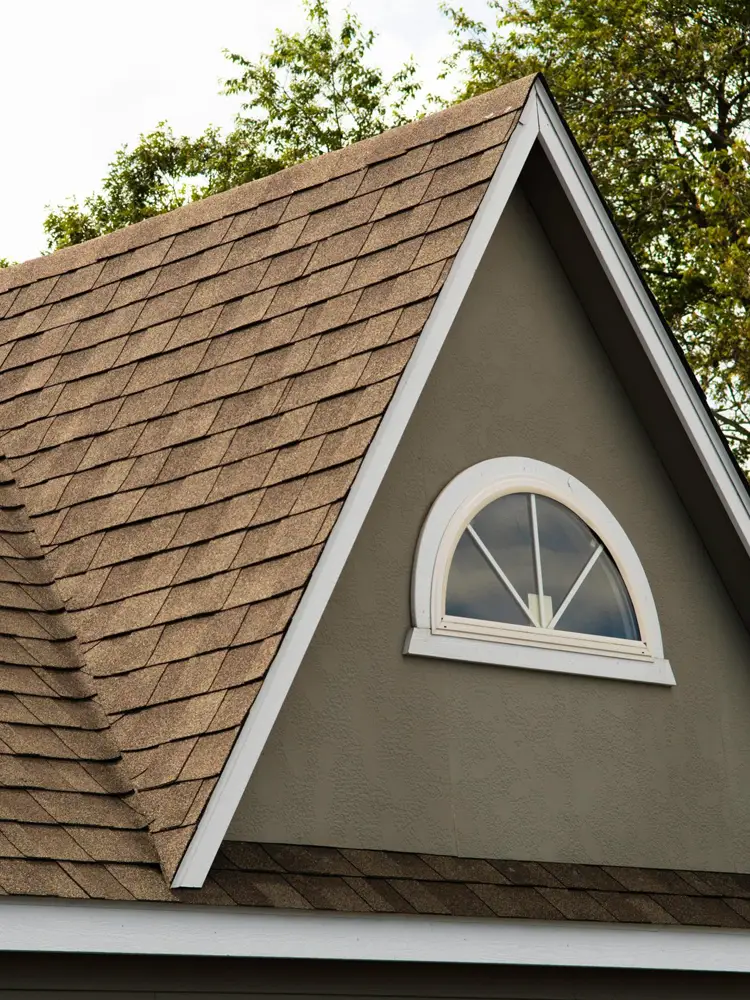

Professional Emergency Roofing Services

Emergency Roofing Services

When a storm rips shingles off your roof at two in the morning, the clock starts immediately. Every minute that your roof remains exposed is a minute that rain, wind, and debris are entering your home, soaking insulation, warping drywall, damaging electrical systems, and creating the conditions for mold growth that can begin within 48 hours of initial moisture contact. In Helper and throughout Carbon County, where severe thunderstorms, heavy hail, and winter blizzards are part of life at elevation, emergency roofing situations are not rare occurrences. They are an inevitable reality that every homeowner should be prepared for.

Shep’s Roofing provides priority emergency roofing response for homeowners and businesses across Utah. When you call (435) 427-1552 with an active roof emergency, we dispatch a crew equipped to stabilize your roof on-site,  stopping the damage in its tracks while we plan the permanent repair. Our goal is simple: protect your property from further loss as fast as humanly possible.

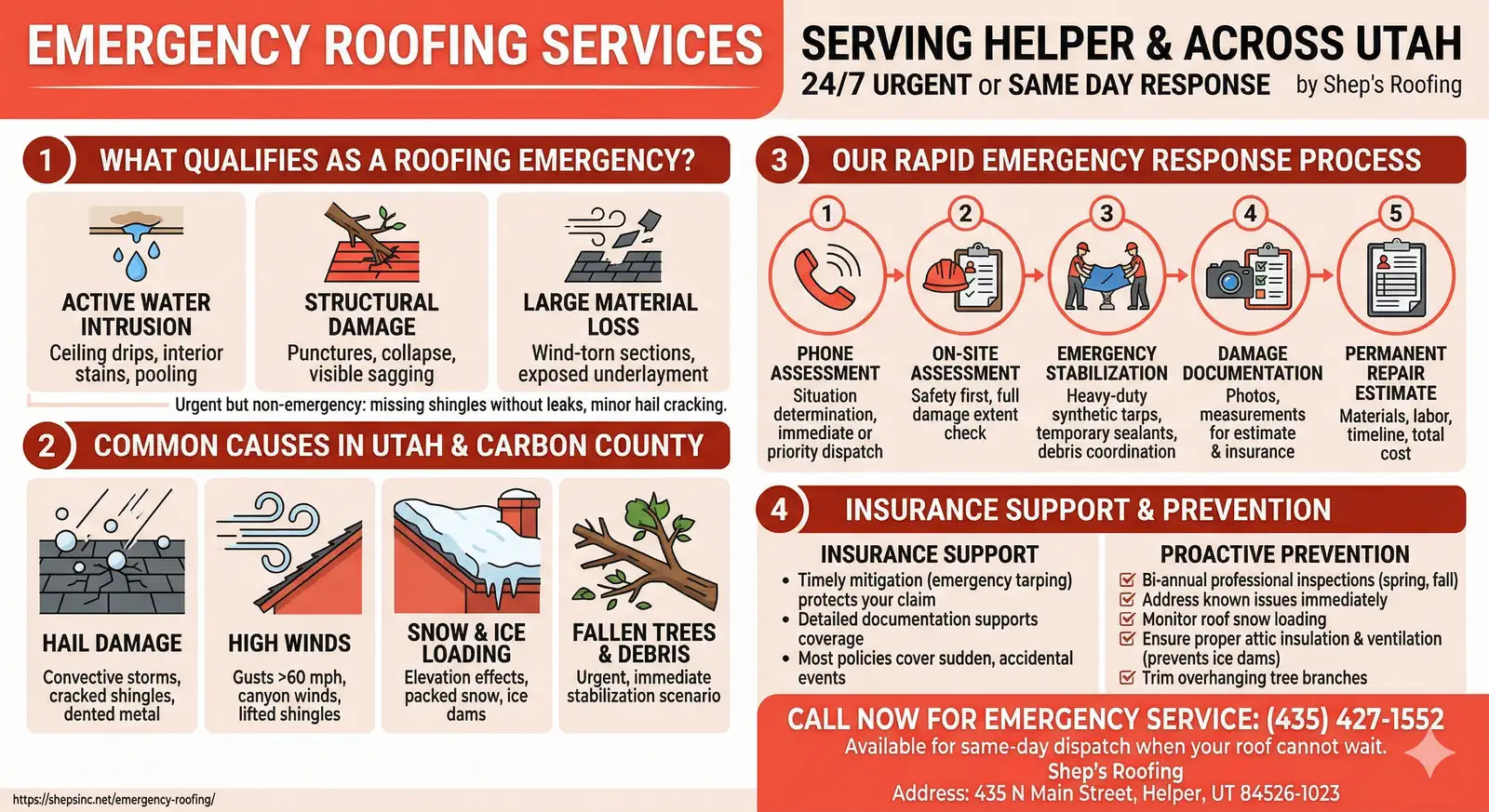
What Qualifies as a Roofing Emergency?

Not every roof problem requires an emergency response, and understanding the difference helps you make the right call. A roofing emergency is any situation where your roof’s protective barrier has been compromised to the point that continued exposure will cause escalating damage to the interior of your home or create a safety hazard for its occupants.

Active water intrusion during or after a storm is the most clear-cut emergency. If water is entering your living space, dripping through the ceiling, running down interior walls, or pooling on floors, the roof has been breached and the situation will worsen with every passing hour. Structural damage is another unambiguous emergency: if a tree limb has punctured the roof, if a section of the roofline has collapsed or is visibly sagging after heavy snow loading, or if large portions of roofing material have been torn away by wind, the home’s structural envelope is compromised and immediate action is needed.

Situations that are urgent but may not require same-hour response include missing shingles after a windstorm with no active interior leaking, damaged flashing that has not yet produced visible water intrusion, or minor hail impact that has cracked shingle surfaces but not penetrated the underlayment. These issues should still be addressed within days rather than weeks, but they do not typically escalate as rapidly as an active breach. When you call us, we will ask targeted questions about the situation to determine the appropriate response timeline and dispatch accordingly.

Common Causes of Roofing Emergencies in Utah

  • Hail damage — The single most common trigger for emergency roof repairs in the Helper area. Carbon County receives convective storms throughout late spring and summer, with several producing hail large enough to crack asphalt shingles, dent metal panels, and shatter pipe boot gaskets in a single pass. The National Weather Service in Salt Lake City has documented multiple significant hail events in Carbon County in recent years. Schedule a professional roof inspection after any confirmed hail event, fractures often don’t produce visible leaks until a subsequent rainstorm washes out the compromised material.
  • High winds — The second leading cause of roofing emergencies. Summer thunderstorms in Carbon County regularly produce gusts exceeding 60 mph, and winter canyon winds can sustain long enough to peel back roofing materials. On aging roofs where seal strips have deteriorated, a single lifted tab can allow wind to progressively strip an entire section, exposing nail lines and underlayment to immediate water penetration during the same storm that caused the damage.
  • Heavy snow and ice loading — The primary winter emergency category. Helper sits at approximately 5,800 feet of elevation, and multi-day storm systems can accumulate snow loads that exceed a roof’s structural design capacity. Ice dams along eaves force meltwater back under shingles, resulting in anything from localized leaking to structural failure. Older homes with pre-modern framing standards are especially vulnerable.
  • Fallen trees and wind-borne debris — The most visually dramatic and often most urgent emergency scenario. Large branches or entire trees dislodged during storms can puncture the roof deck, crush structural framing, and create openings that allow massive volumes of water into the home within minutes. These situations require same-day stabilization without exception.

Our Emergency Response Process for Utah Properties

When you contact Shep’s Roofing with an emergency, we follow a structured response protocol designed to stop additional damage fast and transition efficiently from stabilization to permanent repair.

  • Step 1: Phone Assessment — We ask you to describe the situation: the nature and location of the damage, whether water is actively entering the home, and whether structural compromise or fallen debris is involved. Based on your answers, we determine whether same-hour dispatch is required or whether a next-morning response is appropriate. Active water intrusion, structural damage, or large-scale material loss triggers immediate dispatch.
  • Step 2: Rapid On-Site Damage Assessment — On arrival, our first priority is safety. We verify the structure is stable to work on and clear any hazards, downed power lines, compromised gas lines, or unstable tree limbs, before proceeding. Once the site is cleared, we assess the full extent of the damage, identify all breach points, and determine the stabilization approach.
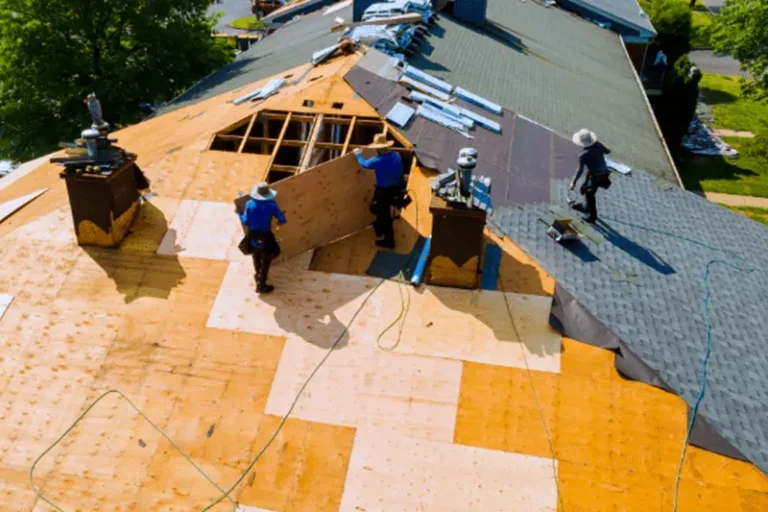
  • Step 3: Emergency Stabilization — We deploy heavy-duty synthetic tarps over all exposed areas, secured with lumber battens and fasteners designed to resist wind uplift. For smaller breaches such as punctures or localized shingle loss, we apply emergency patches or temporary sealants for immediate waterproofing. If a fallen tree or large branch is resting on the roof, we coordinate safe removal before tarping. Our emergency tarping service keeps your home watertight for days or weeks while the permanent repair is planned.
  • Step 4: Damage Documentation — After stabilization, we photograph every aspect of the damage and record measurements and written notes. This documentation serves two critical purposes: it forms the basis of your permanent repair estimate, and it provides the evidence your insurance company needs to process your claim accurately and fairly.
  • Step 5: Permanent Repair Estimate — Within one to three business days of the emergency visit, we deliver a detailed written estimate covering materials, labor, timeline, and total cost. Once you approve the estimate and any insurance coordination is resolved, we schedule the permanent roof repair and restore your roof to full working condition.

Emergency Roofing Situation Guide for Utah Homeowners

Utah’s storms, snow loads, and freeze-thaw cycles can damage your roof without warning. Use this quick-reference guide to identify your situation, understand the risk, and know exactly what to do next to protect your home from further damage.

Emergency Scenario

What You’ll Notice Right Now

Why It’s Urgent in Utah

Shep’s Roofing Response

Your Next Step

Active interior water intrusion

Ceiling drips, spreading stains, wet attic insulation or drywall

Water travels laterally along rafters — visible damage is rarely the full picture

Rapid source triage, temporary sealing or patching, permanent repair plan

Call (435) 427-1552 immediately for same-day dispatch

Hail impact damage

Cracked or dented shingles, pipe boot fractures, granule loss in gutters

Hail fractures often don’t leak until the next rain event washes out compromised material

Full roof documentation for insurance, stabilization of any open areas, repair scheduling

Schedule post-storm inspection within 24–48 hours

Wind-related shingle or ridge cap loss

Missing shingles, lifted edges, displaced ridge caps after high winds

Exposed nail lines and underlayment allow immediate water penetration in the next storm

Damage assessment, tarp deployment over exposed sections, itemized repair estimate

Call for same-day stabilization if large sections are missing

Fallen tree or branch impact

Visible hole or crushed section, exposed decking, debris resting on roof

Large openings allow massive water volumes into the home within minutes

Safe debris coordination, heavy-duty tarp deployment, structural assessment

Call immediately — do not attempt debris removal yourself

Ice dam formation

Water entry near exterior walls in winter, eave staining, interior drips during freeze-thaw

Ice forces meltwater back under shingles — damage worsens with each freeze-thaw cycle

Emergency tarping of affected eave sections, ventilation assessment, underlayment repair plan

Call for same-day or next-morning response during active melt

Heavy snow load stress

Visible roofline sag, interior cracking near load-bearing walls, unusual creaking sounds

Snow loads exceeding 30 lbs/sq ft can compromise rafters and trusses at Helper’s elevation

Safety-first structural evaluation, load relief coordination, decking and framing assessment

Avoid the area — call immediately for urgent structural evaluation

Flashing failure at chimney or skylight

Leaks near chimney walls or skylight frames, worse during wind-driven rain

Transition point failures recur and worsen rapidly if the root cause is not corrected

Flashing reseat or full replacement, surrounding shingle inspection, watertight confirmation

Schedule within 24–48 hours — do not wait for next storm

Pipe boot or vent collar failure

Mystery drips near bathroom or kitchen vents, localized ceiling stain

Utah’s 200+ sunny days accelerate rubber gasket degradation — small failures grow fast

Boot or collar replacement, surrounding area resealed and inspected

Book inspection to confirm source — often repairable same visit

Structural sagging after storm or snow

Soft spots underfoot, visible dip in roofline, interior wall cracking

Compromised decking or framing is a safety hazard — risk escalates with additional loading

Safety-focused evaluation, stabilization, honest repair vs. replacement assessment

Do not access roof — call for urgent on-site evaluation

Flat or low-slope membrane breach

Interior water pooling, visible seam separation, bubbling membrane surface

Water travels freely under flat membranes — a small breach can affect a large interior area

Rapid leak isolation, temporary membrane patch, permanent seam repair or section replacement

Call for same-day response — ponding accelerates membrane failure

Storm Damage: Hail, Wind, and What to Do After

Utah storms can appear quickly and hit hard, especially during late spring and summer when convective activity peaks across Carbon County and the Wasatch Range. Knowing what to do in the hours after a damaging storm can make the difference between a straightforward insurance claim and a prolonged, costly repair process.

  • Prioritize personal safety first — Do not climb onto the roof to inspect damage yourself. Wet, debris-covered roofing surfaces are extremely dangerous. Stay on the ground.
  • Conduct a ground-level visual check — From a safe distance, look for missing shingles, displaced ridge cap, visible holes, or debris resting on the roof surface.
  • Check inside the home — Walk through every room and inspect ceilings and walls for new stains, drips, or wet spots. If you find active water intrusion, place containers to catch dripping water and move valuables away from the affected area immediately.
  • Document everything with photographs — Take wide-angle shots of the overall roof from multiple sides and close-ups of any visible damage, missing shingles, dented gutters, broken flashing, and fallen branches. Photograph all interior damage as well, including ceiling stains, wet flooring, and damaged belongings. This photographic evidence is essential for your insurance claim.
  • Call Shep’s Roofing at (435) 427-1552 — We will determine whether the situation requires same-day emergency response or a priority inspection within one to two business days. Active leaks, structural compromise, or large-scale material loss triggers same-day dispatch. Significant but non-intrusive damage is scheduled for a thorough inspection and estimate as quickly as possible.

Our storm damage roofing services team is equipped to handle the full spectrum of weather-related damage. For homes with widespread hail damage, we conduct a methodical inspection that documents every impact point to support a comprehensive insurance claim. For wind damage, we assess not only the missing or displaced materials but also the underlying components that may have been stressed or exposed during the event.

Why Choose Shep’s Roofing

  • True 24/7 Availability — We answer emergency calls around the clock, every day of the year,  including holidays, weekends, and the middle of the night when storms don’t wait for business hours.
  • Same-Hour Dispatch for Critical Situations — Active water intrusion, structural compromise, and fallen tree impacts trigger immediate crew deployment, not a callback, not a next-day appointment.
  • Storm-Hardened Local Experience — We have responded to Carbon County’s hailstorms, canyon wind events, and heavy snow emergencies for years. We know exactly what these conditions do to Utah roofs and how to stop the damage fast.
  • Stabilization That Actually Holds — Our emergency tarps are secured with lumber battens and wind-resistant fasteners, not loosely draped covers that fail in the next gust. Your home stays protected until permanent repairs are complete.
  • Insurance-Ready Documentation From Day One — Every emergency visit includes timestamped photographs, written damage descriptions, and an itemized estimate formatted for insurance adjuster review, giving your claim the strongest possible foundation.
  • One Crew, Start to Finish — The same team that stabilizes your roof handles the permanent repair. No handoffs, no miscommunication, no starting over with a new contractor.
  • No Price Gouging After Storms — We charge fair, consistent rates regardless of storm season demand. Utah homeowners deserve honest pricing when they are most vulnerable, and that is exactly what we deliver.

Filing Emergency Insurance Claims in Utah

Most homeowner’s insurance policies in Utah cover roof damage caused by sudden and accidental events, storms, hail, wind, fallen trees, and ice dams. However, the claims process has specific requirements and timelines that can affect your coverage if not followed correctly.

The Federal Emergency Management Agency (FEMA) recommends contacting your insurance provider within 24 to 48 hours of discovering storm damage. Many Utah policies include a requirement that homeowners take reasonable steps to prevent additional damage after a covered event, which is exactly what emergency tarping provides. Failing to mitigate further damage can give your insurer grounds to deny coverage for losses that occurred after the initial event. In other words, the cost of emergency stabilization is not just about protecting your home; it also protects your insurance claim.

Shep’s Roofing assists homeowners throughout the claims process. Our emergency damage documentation,  timestamped photographs, written descriptions, and measurements, is formatted to meet insurance industry standards. We provide a detailed, itemized repair estimate that your adjuster can review directly, and we are available to meet with adjusters on-site to walk through the scope of work and answer technical questions. Our documentation is thorough and transparent, which helps ensure your claim is processed accurately and that you receive the coverage you are entitled to.

It is important to understand what insurance typically does not cover. Damage resulting from deferred maintenance, a leak that has been slowly worsening for months, shingles that were already past their service life, or flashing that was never properly installed, is generally excluded. Maintaining records of regular roof inspections and timely repairs demonstrates to your insurer that the roof was in proper condition prior to the storm event, strengthening your claim.

Preventing Roofing Emergencies: Proactive Steps for Utah Homeowners

You cannot control Utah’s weather, but you can significantly reduce the likelihood that a storm produces an emergency-level roof failure. These proactive steps are your best defense against the damage that triggers urgent calls.

  • Schedule professional inspections twice a year — Once in spring after the winter snow season and once in fall before the first freeze. These inspections catch deteriorating flashing, lifting shingle tabs, cracked pipe boots, and clogged drainage before they become failure points during a storm. A $200 inspection that identifies a failing flashing section can prevent a $3,000 emergency repair when the next thunderstorm arrives.
  • Address known issues immediately — A missing shingle, a loose ridge cap, or a cracked pipe boot may cause no problems under calm conditions, but each becomes a potential breach point during high winds or driving rain. The gap between a minor maintenance item and a full emergency is often a single storm.
  • Monitor roof snow loading during winter storms — Helper sits at approximately 5,800 feet, and heavy snowfall is a seasonal certainty. The International Code Council recommends professional assessment when snow accumulation approaches a roof’s design load threshold,  for most Utah residential structures, approximately 30 pounds per square foot, which corresponds to roughly 2.5 to 3 feet of packed snow depending on moisture content. Contact a professional for safe removal rather than attempting it yourself.
  • Ensure proper attic insulation and ventilation — Inadequate attic ventilation is the primary cause of ice dam formation, one of the most common winter roofing emergencies. When warm air leaks into an unventilated attic, it melts snow on the upper roof deck unevenly, and the resulting water refreezes at the colder eaves, creating a dam that forces water back under the shingles. Proper ventilation eliminates the temperature differential that drives this cycle.
  • Trim overhanging tree branches — Dead limbs and overextended branches are the first casualties of high winds. A large branch falling from even moderate height can puncture roofing material and decking. Maintain at least six feet of clearance between tree limbs and the roof surface to significantly reduce this risk.

Testimonials

What They’re Saying About Us

***REVIEWS GO HERE***

Proudly Serving Utah With 24/7 Emergency Roofing Services

When your roof fails, every hour counts. Shep’s Roofing delivers rapid emergency roofing response from our home base in Helper, UT, covering Carbon County and extending across the entire state, available around the clock for active leaks, storm damage, structural failures, and fallen tree impacts. Our service areas include Salt Lake City, Provo, West Valley City, West Jordan, St. George, Lehi, Orem, Sandy, Eagle Mountain, Herriman, and Saratoga Springs. Explore our complete list of coverage zones on our Service Areas page. No matter where you are in Utah, our licensed crew arrives ready to stabilize, document, and repair, so your home is protected when it matters most.

Call Now for Emergency Roof Service in Utah

Roof damage does not wait for business hours, and neither should your response. Every hour of delay allows water, wind, and debris to compound the damage inside your home, turning a manageable repair into a major restoration project. Shep’s Roofing provides rapid emergency response with on-site stabilization, thorough damage documentation, and a clear path from temporary protection to permanent repair.

Call (435) 427-1552 now for emergency service, or request your free estimate online for non-emergency repairs. We are available for same-day dispatch when your roof cannot wait.

Frequently Asked Questions

How quickly can you respond to an emergency call in Utah?

For active leaks, structural damage, and storm-related breaches, we offer same-day dispatch. Response time depends on crew availability and weather conditions, but our goal is to have a team on-site as quickly as possible to stop further damage. Non-emergency storm damage inspections are typically scheduled within one to two business days.

Place buckets or containers under any active drips to protect flooring and belongings. If it is safe to do so, move furniture and valuables away from the affected area. Do not attempt to climb onto the roof, wet, damaged roofing surfaces are extremely dangerous. Take photographs of any visible damage from ground level and from inside the home to support your insurance claim.

Emergency tarping and stabilization typically costs between $300 and $800, depending on the size of the exposed area and the severity of the damage. Permanent repair costs depend on the scope of the damage and the materials involved. We provide a detailed written estimate for the permanent repair within one to three business days of the emergency visit, with no obligation.

Most Utah homeowner’s policies cover roof damage caused by sudden events such as storms, hail, wind, and fallen trees. Emergency stabilization costs, including tarping, are typically reimbursable as part of the homeowner’s duty to mitigate further damage. We provide detailed documentation formatted for insurance claims and are available to meet with your adjuster on-site.

We provide both. Emergency tarping is the immediate stabilization step, and the permanent roof repair follows once the damage is fully assessed, the estimate is approved, and materials are ordered. If our assessment reveals that the damage is extensive enough to warrant a roof replacement rather than a repair, we will explain the options transparently and provide pricing for both paths.

We respond to emergencies on all residential and commercial roofing systems, including asphalt shingles, metal roofing, flat roof membranes, and tile. Our crew carries materials for multiple roof types to ensure we can stabilize the situation regardless of your roofing system.

Yes. The primary cause of ice dams is inadequate attic insulation and ventilation. Ensuring that your attic has proper airflow and sufficient insulation prevents the uneven snowmelt that creates ice dams in the first place. Our team can assess your attic ventilation during any inspection and recommend improvements. For more information, visit our blog or FAQ page.

If we arrive and determine that the situation does not require emergency stabilization, we will let you know and schedule a standard inspection and repair at your convenience. We do not charge for emergency assessments that result in no immediate work. Honest communication is central to how we operate, you can read what past clients say on our testimonials page.

Get in Touch with Us

Shep’s Roofing

435 N Main St, Helper, UT 84526

(435) 472-1552

Monday: 8AM – 8PM
Tuesday: 8AM – 8PM
Wednesday: 8AM – 8PM
Thursday: 8AM – 8PM
Friday: 8AM – 8PM
Saturday: 8AM – 8PM
Sunday: Closed

***MAP GOES HERE***

Quality roofing provider

Connect With Us

Shep’s Roofing
435 N Main St, Helper, UT 84526
(435) 472-1552
Mon–Sat: 8 AM – 8 PM