

Flat Roof Systems

Flat Roof Systems - Shep's Roofing

Flat and low-slope roofs cover the majority of commercial buildings in the United States, warehouses, retail centers, office complexes, industrial facilities, and multi-tenant properties all rely on roof assemblies designed to perform at slopes of 2:12 or less. Managing water, snow load, thermal movement, and UV exposure on a surface where gravity provides minimal drainage assistance requires engineering precision, material knowledge, and installation discipline that most residential roofers simply do not possess.

Shep’s Roofing designs, installs, repairs, and maintains complete flat roof systems for commercial building owners in Helper, Carbon County, and throughout Utah. Our flat roof work covers every component of the assembly, structural deck preparation, vapor retarders, rigid insulation, tapered drainage insulation, membrane application, flashing details, and drainage system integration. We work with TPO, EPDM, PVC, modified bitumen, and built-up roofing (BUR) membranes, selecting the system that matches each building’s structural requirements, performance goals, and budget.

Common Flat Roof Problems in Utah and How We Solve Them

Flat roofs are reliable when properly designed and maintained, but they are not immune to problems. The following are the issues Shep’s Roofing encounters most frequently on commercial flat roofs in Utah.

Ponding Water

Ponding is the most common flat roof complaint and the most preventable. It results from inadequate original slope design, settled or compressed insulation, blocked drains, or structural deflection that creates low spots. Shep’s Roofing resolves ponding with tapered insulation retrofits that re-establish positive drainage, drain relocation or addition, and structural evaluation when deflection is suspected. Eliminating ponding is often the single most impactful repair we can make on an existing flat roof.

Membrane and Seam Failures

Membrane tears, punctures, and seam separations allow water into the insulation and deck below. On flat roofs, water that enters the assembly does not drain out, it spreads laterally through the insulation, saturating a far larger area than the original breach. Our roof leak detection services locate the precise entry point so repairs target the actual problem rather than chasing symptoms across the roof surface. Targeted roof repairs using heat-welded patches and manufacturer-specified materials restore the membrane to warranted condition.

Flashing Deterioration

Flashing failures at walls, curbs, pipes, and equipment penetrations are the leading cause of flat roof leaks. Sealant-dependent flashings are particularly vulnerable in Utah’s climate because UV exposure degrades sealant compounds and thermal cycling works sealant joints open over time. Shep’s Roofing replaces failed sealant-dependent flashings with mechanically terminated, membrane-integrated details that do not rely on caulk for long-term waterproofing.

Insulation Saturation

When water penetrates the membrane and enters the insulation layer, the insulation boards absorb moisture and lose their thermal performance. Wet insulation also traps moisture against the structural deck, promoting corrosion on steel decks and rot on wood decks. During roof inspections, Shep’s Roofing performs infrared scanning or core sampling to identify saturated insulation areas. Localized insulation replacement combined with membrane repair can restore system performance without requiring a full roof replacement, but only if the damage has not spread too far.

Components of a Commercial Flat Roof System

A flat roof is not a single product, it is an engineered assembly of multiple components that must work together as a system. Understanding what goes into that assembly helps building owners make informed decisions about materials, costs, and long-term maintenance.

Structural Roof Deck

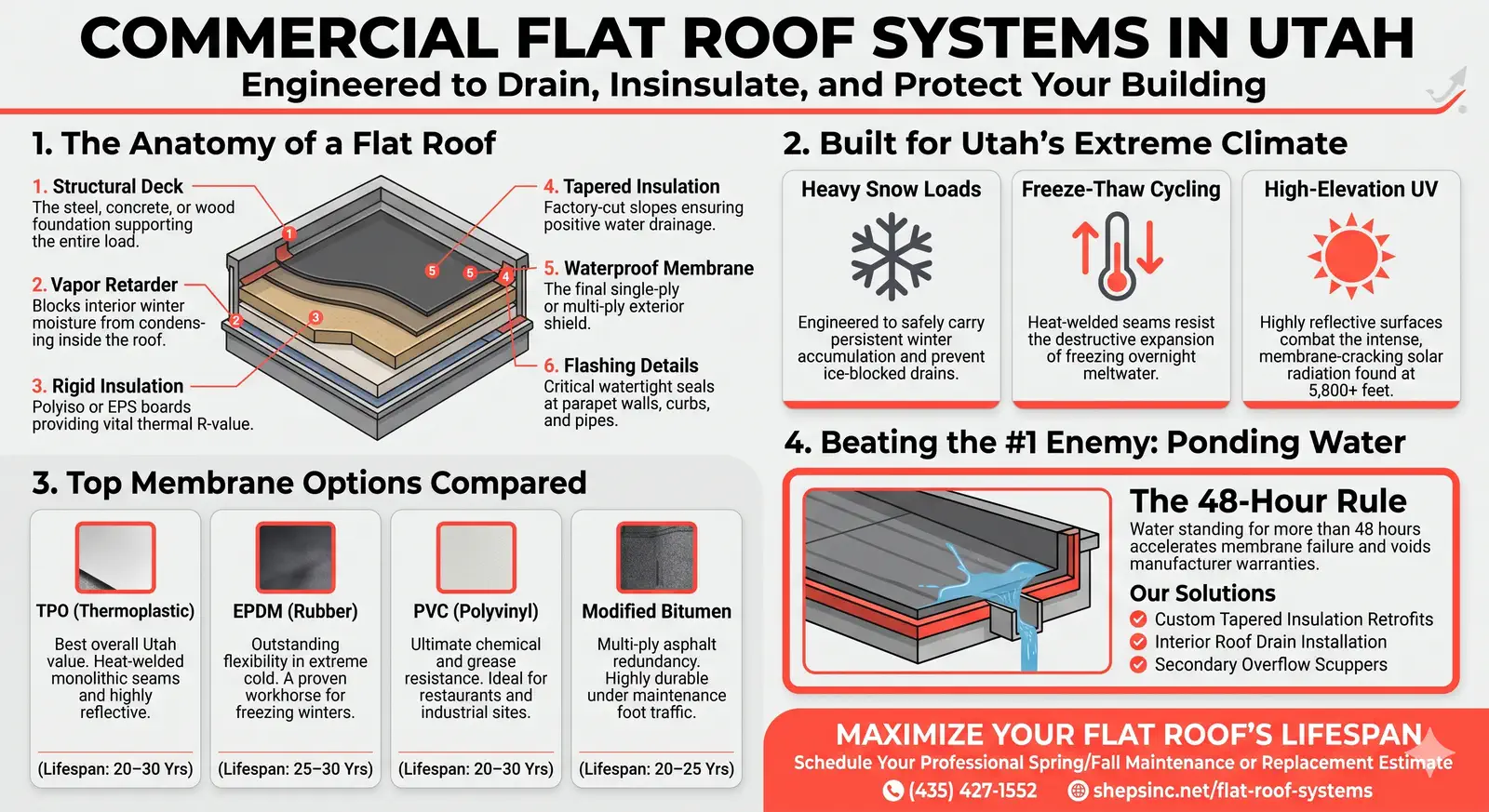
The deck is the structural foundation that carries the entire roof assembly plus any live loads, snow accumulation, rooftop equipment, maintenance foot traffic, and wind uplift forces. Commercial flat roofs in Utah typically sit on steel, concrete, or wood decks. The deck type determines which membrane attachment methods are available (mechanical fastening, adhesive, ballast) and influences the overall system weight capacity. Before any new roof installation, Shep’s Roofing evaluates the deck condition to confirm it can safely support the proposed assembly.

Vapor Retarder

In Utah’s climate, where interior heated spaces create significant vapor drive toward the cold exterior during winter months, a vapor retarder installed below the insulation prevents moisture from migrating into the roof assembly and condensing within the insulation layer. Moisture-laden insulation loses its R-value, adds dead weight, and accelerates the deterioration of the membrane and deck above and below it. Not every flat roof requires a vapor retarder, but buildings in Helper and Carbon County with heated interiors and cold winter exposure are strong candidates.

Rigid Insulation

Insulation in a flat roof system serves two functions: thermal performance and drainage slope creation. Flat-stock rigid insulation boards, polyisocyanurate (polyiso), expanded polystyrene (EPS), or extruded polystyrene (XPS), provide the R-value required by Utah’s energy code. The International Code Council publishes the minimum insulation standards adopted in Utah’s building code cycle, and commercial buildings must meet or exceed these requirements at the time of reroofing.

Tapered Insulation for Drainage

Truly flat roofs are an engineering problem, not a design goal. Any flat surface that holds water for more than 48 hours is classified as having a ponding condition, and ponding water accelerates membrane degradation, adds structural load, voids most manufacturer warranties, and creates conditions for biological growth and ice damage during winter.

Tapered insulation systems, factory-cut rigid insulation boards with a built-in slope, create positive drainage across the roof surface, directing water toward drains, scuppers, or gutters. Shep’s Roofing designs tapered insulation layouts for every flat roof installation and offers tapered insulation retrofits for existing buildings with ponding problems. Proper drainage design is the single most impactful decision in flat roof performance and longevity.

Membrane

The membrane is the waterproofing surface, the component building owners see and think of as “the roof.” On a flat commercial building, this is typically a single-ply membrane (TPO, EPDM, or PVC), a multi-ply modified bitumen or built-up system, or a fluid-applied roof coating over an existing substrate. Each membrane type has specific advantages covered in depth on our commercial roofing parent page and our TPO roofing subpage.

Flashing and Edge Details

Flashings are the waterproofing transitions at every point where the membrane meets a vertical surface, changes plane, or terminates, walls, parapets, curbs, penetrations (pipes, vents, HVAC units, skylights), drains, and roof edges. Flashing failures are the number one source of leaks on commercial flat roofs. The membrane field can be in perfect condition, but a single compromised flashing detail at a pipe penetration or parapet wall can send water into the building.

Shep’s Roofing treats flashing details as the most critical phase of every flat roof installation. Our crews fabricate and install flashings to manufacturer specifications using compatible materials, not generic caulk or peel-and-stick patches that fail within a few seasons under Utah’s UV exposure and thermal cycling.

Flat Roof Membrane Systems Compared: TPO vs. EPDM vs. Modified Bitumen vs. BUR for Utah Buildings

Selecting the right flat roof membrane is one of the most consequential decisions a Utah commercial building owner makes, the wrong system for your building’s conditions, drainage pattern, or occupancy type will underperform regardless of installation quality. The table below provides a comprehensive side-by-side comparison of every flat roof membrane system Shep’s Roofing installs across Helper, Carbon County, and throughout Utah.

Membrane System

Type

Typical Lifespan

Seam Method

Ponding Tolerance

UV Resistance

Snow Load Performance

Installed Cost Per Sq Ft

Best Suited For

Utah Climate Rating

TPO (Thermoplastic Polyolefin)

Single-ply thermoplastic

20–30 years

Heat-welded

Good — white surface resists UV degradation in ponding

Excellent — white reflective surface

Very Good — flexible in cold temps

$5.50–$9.00

Most commercial flat roofs — best overall Utah value

Outstanding — freeze-thaw resistant seams, high reflectivity

PVC (Polyvinyl Chloride)

Single-ply thermoplastic

20–30 years

Heat-welded

Very Good — chemical and ponding resistant

Excellent

Very Good

$6.00–$10.00

Restaurants, chemical exposure environments, rooftop gardens

Excellent — superior seam strength in thermal cycling

EPDM (Rubber)

Single-ply thermoset

25–30 years

Adhesive or tape

Good — but dark surface absorbs heat

Very Good — UV stable over time

Excellent — most flexible in extreme cold

$4.50–$8.00

Buildings in extreme cold zones, low-slope sections

Very Good — outstanding cold flexibility at Helper’s elevation

Modified Bitumen (SBS)

Multi-ply modified asphalt

20–25 years

Heat-welded or cold adhesive

Good

Good

Very Good — SBS modifier maintains flexibility in cold

$5.00–$8.50

Moderate traffic roofs, BUR replacement projects

Very Good — SBS modifier suited to Utah’s cold climate

Modified Bitumen (APP)

Multi-ply modified asphalt

20–25 years

Torch-applied

Good

Good — torch-applied granule surface

Good

$5.00–$8.00

Warmer Utah markets — St. George area

Good — APP less flexible than SBS in cold temperatures

Built-Up Roofing (BUR)

Multi-ply felt and bitumen

20–30 years

Hot mopped or cold adhesive

Good — gravel ballast aids drainage

Good — gravel surface provides UV protection

Good

$5.50–$9.00

Large commercial roofs, reroofing over existing BUR

Good — proven system, heavy and durable

Spray Polyurethane Foam (SPF)

Fluid-applied foam insulation

20–25 years with recoating

Seamless — fluid applied

Excellent — seamless application eliminates seam failure

Requires protective coating

Very Good — adds insulation R-value

$6.00–$10.00

Irregular roof shapes, insulation upgrade priority

Very Good — seamless system eliminates freeze-thaw seam risk

Flat Roof Challenges Specific to Helper and Utah

Utah’s climate creates a specific set of conditions that flat roofs must be designed to withstand. Building owners in Helper and Carbon County face environmental stresses that demand more from a flat roof assembly than buildings in milder, lower-elevation regions.

Snow Load and Structural Stress

Helper receives significant winter snowfall, and commercial flat roofs accumulate snow loads that can persist for weeks when temperatures remain below freezing. Unlike sloped roofs that shed snow naturally, flat roofs retain it, adding dead load that the structural deck and supporting members must carry. Proper structural evaluation before roof installation ensures the building can handle both the roof assembly weight and the maximum expected snow load without deflection or failure.

During heavy snow years, flat roof drains can become blocked by ice and compacted snow, preventing meltwater from leaving the roof surface. This creates localized ponding that adds even more load. Shep’s Roofing designs drainage systems with redundancy, primary interior drains supplemented by overflow scuppers or secondary drains, so water always has an exit path even when the primary system is compromised.

Freeze-Thaw Cycling

The daily freeze-thaw cycles that occur throughout Utah’s winter and transitional seasons are among the most destructive forces acting on a flat roof. Water from daytime snowmelt migrates into any available opening, membrane seams, flashing edges, fastener penetrations, and refreezes overnight, expanding and mechanically forcing those openings wider. Each cycle compounds the damage.

This is why membrane seam integrity and flashing quality matter so much on flat roofs in this climate. Heat-welded TPO and PVC seams resist freeze-thaw damage far better than adhesive-sealed or tape-sealed EPDM seams, which is one reason single-ply thermoplastic membranes have gained market share in the Utah commercial roofing market over the past decade.

UV Degradation at Elevation

At Helper’s elevation of approximately 5,800 feet, UV radiation intensity is substantially higher than at sea level. Flat roofs present the worst-case UV exposure scenario, the entire membrane surface faces directly skyward with no slope to reduce the incident angle. Every polymer-based membrane degrades under sustained UV exposure, and higher elevation accelerates that process.

Reflective white membranes (TPO, PVC, white EPDM) and reflective roof coatings mitigate UV damage by reflecting solar energy rather than absorbing it. For flat roofs in Helper and Carbon County, specifying a reflective membrane or applying a reflective coating to an existing dark-surfaced roof is both an energy efficiency strategy and a longevity strategy.

Why Choose Shep’s Roofing

  • Multi-System Expertise — We install, repair, and replace TPO, EPDM, modified bitumen, built-up roofing, and SPF systems. We recommend the right membrane for your building’s specific drainage conditions, occupancy type, and budget rather than defaulting to whatever product we happen to stock.
  • Seam Integrity as a Non-Negotiable Standard — The seam is the most vulnerable point on any flat roof membrane. Our crews are trained in heat-welded seam techniques for TPO and PVC systems and proper adhesive application for EPDM systems, and every seam is inspected before the project closes.
  • Drainage Assessment on Every Project — Ponding water is the primary cause of flat roof failure in Utah. We evaluate existing drainage infrastructure, scupper placement, and slope adequacy before installation begins, and we flag drainage deficiencies that will shorten the life of any new membrane if left unaddressed.
  • Utah Snow Load Knowledge — Flat roofs in Helper and Carbon County face significant snow accumulation risk each winter. We specify membranes, insulation, and attachment methods that account for Utah’s ground snow load requirements at elevation, and we advise building owners on load monitoring during heavy snow seasons.
  • Honest Repair vs. Replacement Guidance — We perform core cuts and moisture surveys to determine whether an existing flat roof can be repaired or restored with coating, or whether full replacement is the only viable path. We never recommend replacement when repair will solve the problem.
  • Warranty Compliant Installations — Every flat roof system we install follows manufacturer specifications for membrane attachment, insulation compatibility, and detail work, ensuring full warranty activation on every project.

Flat Roof Drainage Systems in Utah

Drainage design is the engineering backbone of every flat roof system. Without proper drainage, even the best membrane and insulation assembly will fail prematurely. Shep’s Roofing integrates drainage planning into every flat roof project from the initial design phase.

Interior Roof Drains

Interior drains are positioned at low points across the roof surface and connect to the building’s internal storm drainage piping. They are the most common primary drainage method on large commercial flat roofs. Interior drains keep water management entirely within the building footprint, avoiding the exterior downspout runs and freeze exposure that external drainage systems face during Utah winters.

Scuppers and Overflow Drains

Scuppers are openings through parapet walls that allow water to exit the roof surface and discharge through downspouts on the building exterior. Scuppers serve as either primary drainage or secondary overflow protection, a critical safety redundancy that prevents catastrophic water accumulation if primary drains become blocked by debris or ice. Utah’s building code requires secondary drainage on commercial flat roofs, and Shep’s Roofing designs every system with this redundancy built in.

Gutter Systems

For low-slope commercial buildings with eave edges rather than parapets, gutter and downspout systems collect runoff at the roof perimeter. Gutter sizing must account for the maximum expected rainfall intensity for the building’s geographic location, Carbon County’s spring thunderstorm events can produce brief high-intensity rainfall that overwhelms undersized gutters and causes water backup onto the roof surface.

Flat Roof Service Life and Performance by System: Utah Market Data

Understanding how long each flat roof system realistically performs in Utah’s specific climate helps building owners plan capital expenditures, maintenance budgets, and replacement timelines with confidence. The estimates below are based on real-world performance data from commercial roofing projects across Helper, Carbon County, and the broader Utah market.

Roof System

Manufacturer Rated Lifespan

Realistic Utah Lifespan (Maintained)

Realistic Utah Lifespan (Unmaintained)

Primary Lifespan Threat in Utah

Recoatable for Life Extension

Typical Replacement Cost Per Sq Ft

TPO (60-mil)

20–30 years

22–28 years

12–18 years

UV surface degradation and seam stress from thermal cycling

Yes — silicone or acrylic coating adds 10–15 years

$5.50–$9.00

TPO (80-mil)

25–30 years

25–30 years

15–20 years

Seam stress from extreme thermal cycling

Yes

$7.00–$11.00

PVC (50-mil)

20–30 years

22–28 years

12–18 years

Plasticizer migration in extreme cold

Yes

$6.00–$10.00

EPDM (60-mil)

25–30 years

25–30 years

15–20 years

Seam adhesive failure from freeze-thaw cycling

Yes — silicone coating compatible

$4.50–$8.00

EPDM (90-mil)

30+ years

28–35 years

18–25 years

Seam adhesive failure — reduced in thicker membrane

Yes

$6.00–$10.00

Modified Bitumen SBS

20–25 years

20–25 years

12–18 years

Surface oxidation and UV granule degradation

Yes — elastomeric coating extends life

$5.00–$8.50

Built-Up Roofing (BUR)

20–30 years

20–28 years

12–18 years

Gravel loss exposing bitumen surface to UV

Yes — aluminum fibered coating

$5.50–$9.00

SPF with coating

20–25 years per coating cycle

20–25 years

10–15 years

UV degradation of protective coating — recoating required

Yes — recoating is the standard maintenance cycle

$6.00–$10.00

Flat Roof Maintenance for Utah Building Owners

Proactive maintenance is the most cost-effective way to maximize the service life of a flat roof system. The National Roofing Contractors Association (NRCA) recommends professional inspections at least twice per year for commercial flat roofs, plus additional inspections after significant weather events.

For buildings in Helper and Carbon County, the optimal inspection schedule includes a spring inspection after winter weather to assess any freeze-thaw damage, snow load effects, or ice dam formation that occurred during the cold season, and a fall inspection before the snow season to clear drains, verify flashing integrity, and address any issues before winter conditions prevent access.

Between professional inspections, building maintenance staff should keep drains and scuppers clear of debris, avoid storing materials or equipment on the roof surface without protective walk pads, and report any interior water stains or ceiling discoloration immediately, by the time water shows inside the building, the damage within the roof assembly may already be extensive.

Testimonials

What They’re Saying About Us

***REVIEWS GO HERE***

Proudly Serving Utah With Expert Flat Roof System Services

From TPO and EPDM membrane installations to modified bitumen repairs and built-up roofing replacements, Shep’s Roofing delivers comprehensive flat roof system services from our home base in Helper, UT,  extending across Carbon County and throughout the entire state. Our service areas include Helper, Salt Lake City, Provo, West Valley City, West Jordan, St. George, Lehi, Orem, Sandy, Eagle Mountain, Herriman, and Saratoga Springs. Explore our complete list of coverage zones on our Service Areas page.

Whether you are managing a commercial property, adding a flat roof section to a residential build, or dealing with a leaking low-slope membrane that has failed through Utah’s freeze-thaw cycles and heavy snow seasons, our licensed crew brings the right materials, the right installation methods, and honest assessments to every flat roofing project we take on across Utah.

Schedule a Flat Roof Assessment in Helper and Across Utah

Whether you need a new flat roof installation for a commercial building, repairs on an existing system, a drainage redesign to eliminate ponding, or a professional inspection to understand your roof’s current condition, Shep’s Roofing delivers the specialized flat roof expertise that Utah’s commercial buildings require.

Call (435) 427-1552 or visit our contact page to schedule your free roof estimate.

Frequently Asked Questions

How long does a flat commercial roof last in Utah?

Flat roof service life depends on the membrane system selected, installation quality, and maintenance consistency. TPO and PVC systems typically deliver 20 to 30 years. EPDM provides 25 to 30 years. Modified bitumen and BUR systems last 20 to 25 years. In Utah’s high-UV, freeze-thaw environment, consistent maintenance and timely repairs are the most important factors in reaching the upper end of any system’s expected lifespan.

Standing water,  ponding, results from inadequate slope, compressed or deteriorated insulation, structural deflection, or blocked drainage. Ponding is not normal and should be corrected because it accelerates membrane degradation, adds structural load, and voids most manufacturer warranties. Shep’s Roofing designs tapered insulation solutions that eliminate ponding on both new and existing flat roofs.

While technically possible, converting a flat commercial roof to a sloped structure is a major construction project involving structural engineering, permitting, and significant cost. In most cases, addressing flat roof performance through proper drainage design, quality membrane installation, and ongoing maintenance is far more practical and cost-effective than structural conversion.

The best membrane depends on your building’s specific conditions. TPO is the most widely specified for its combination of energy efficiency, seam strength, and installed cost. PVC offers superior chemical resistance. EPDM provides proven long-term flexibility. Modified bitumen delivers multi-ply redundancy. Our inspection and assessment process matches the right system to your building.

Wet insulation is not always visible from above, the membrane may look intact while the insulation below is saturated. Professional detection methods include infrared thermography (which identifies temperature differentials caused by moisture), core sampling (which physically extracts insulation samples for inspection), and electronic leak detection. Shep’s Roofing uses these methods during inspections to identify hidden moisture before it causes structural damage.

Not necessarily. Many flat roof leaks are caused by localized membrane failures, flashing deterioration, or drainage problems that can be repaired without full replacement. If the leak has caused widespread insulation saturation or deck damage, partial or full replacement may be warranted. A professional roof inspection determines the extent of damage and the most cost-effective path forward, repair, coating restoration, or replacement.

Get in Touch with Us

Shep’s Roofing

435 N Main St, Helper, UT 84526

(435) 472-1552

Monday: 8AM – 8PM
Tuesday: 8AM – 8PM
Wednesday: 8AM – 8PM
Thursday: 8AM – 8PM
Friday: 8AM – 8PM
Saturday: 8AM – 8PM
Sunday: Closed

***MAP GOES HERE***

Quality roofing provider

Connect With Us

Shep’s Roofing
435 N Main St, Helper, UT 84526
(435) 472-1552
Mon–Sat: 8 AM – 8 PM