



Expert Roof Leak Detection Services

Roof Leak Detection Services

In Helper and throughout Carbon County, where heavy spring snowmelt, summer thunderstorms, and winter ice dams create year-round moisture threats, early and accurate leak detection is essential to protecting your home’s structure and your family’s health.

Shep’s Roofing specializes in professional roof leak detection for homeowners and businesses across Utah. Our technicians don’t just find leaks, they trace each one back to its precise origin point, determine the underlying cause, and deliver a clear repair plan so the problem is resolved permanently. Whether you suspect a single drip or are dealing with persistent water intrusion that previous contractors could not locate, our systematic approach gets to the source.

Why Roof Leaks Are So Difficult to Find in Utah

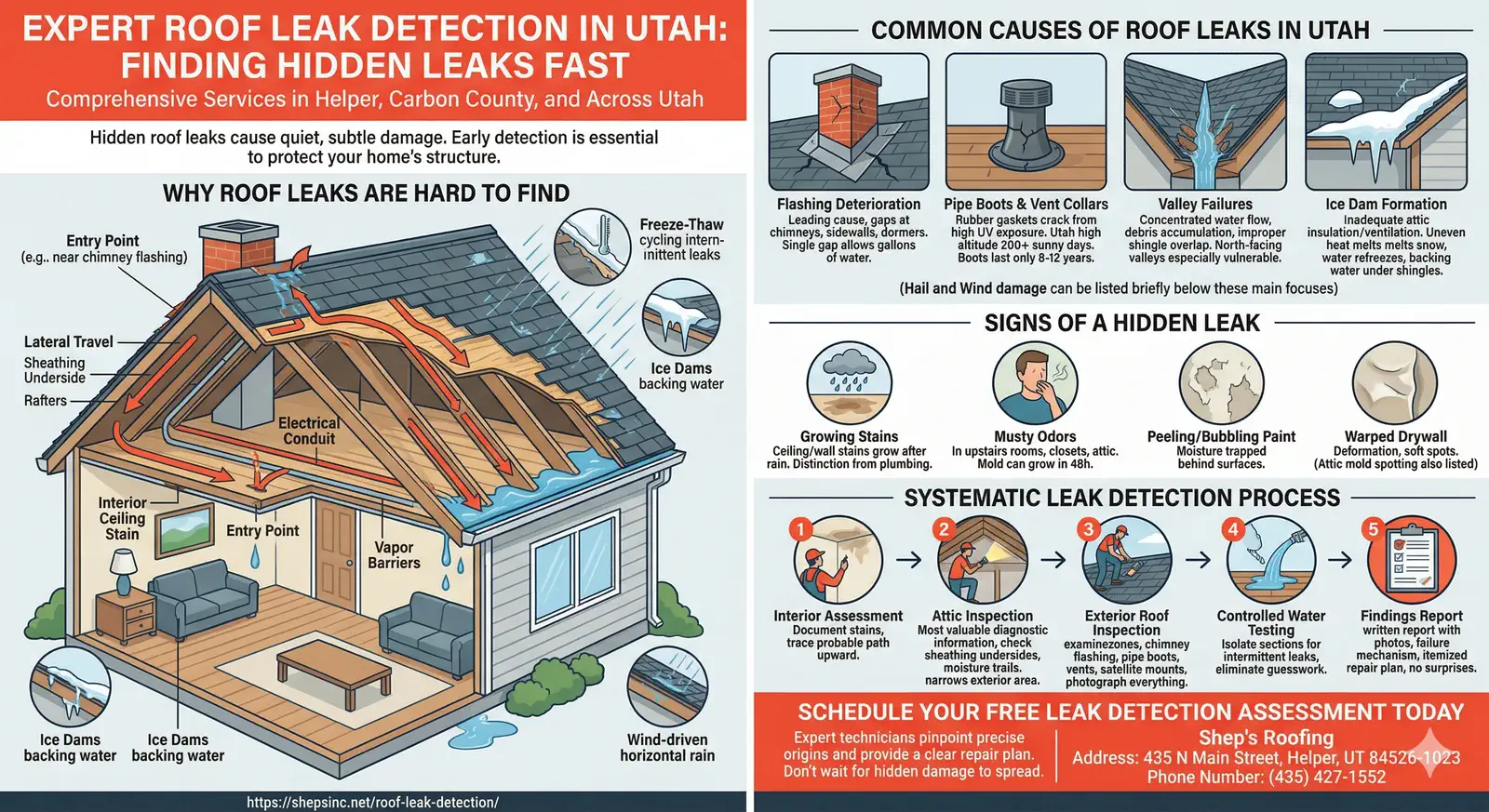
One of the most frustrating aspects of a roof leak is the disconnect between where water appears inside your home and where it actually enters the roof. Water that penetrates the roof surface does not always fall straight down. It can travel laterally along the underside of the roof sheathing, run down rafters, follow electrical conduit, and pool on top of vapor barriers before finding a gap to drip through to the living space below. A ceiling stain in a second-floor bedroom might originate from a flashing failure on the opposite side of the roof, ten or fifteen feet away.

Utah’s climate adds another layer of complexity. In Helper, where winter temperatures regularly drop below freezing, ice dams form along eaves when heat escaping from the attic melts snow on the upper roof surface, and the resulting water refreezes at the colder eave edge. The ice creates a dam that forces water back up under the shingles, where it penetrates the underlayment and enters the roof assembly. These leaks are intermittent, they may only appear during specific freeze-thaw conditions, which makes them particularly difficult to diagnose without experienced eyes and the right approach.

Wind-driven rain is another common culprit in Carbon County. During summer thunderstorms, rain does not fall vertically, gusts can push water horizontally under shingle edges, into ridge vents, and through gaps in flashing that would remain watertight in calm conditions. According to the National Weather Service in Salt Lake City, Carbon County averages 15 to 20 thunderstorm days per year, with several of those producing wind gusts above 50 miles per hour. These storms create leak conditions that only manifest under specific weather patterns, which is why a leak that appeared during last month’s storm may be impossible to reproduce on a dry inspection day without proper water testing methods.

Common Causes of Roof Leaks in Helper & Across Utah

Understanding the most frequent causes of roof leaks helps homeowners recognize risk factors early and prioritize preventive maintenance. These issues account for the vast majority of leak calls our team responds to across Helper and Carbon County.

  • Flashing deterioration — The leading cause of roof leaks. Utah’s extreme temperature swings cause flashing sealant to crack and metal to expand and contract, creating gaps at chimneys, sidewalls, and dormers. A single quarter-inch gap in chimney step flashing can allow several gallons of water into the roof assembly during a moderate rainstorm.
  • Pipe boot and vent collar failure — The rubber gaskets sealing plumbing vent pipes and exhaust vents deteriorate under constant UV exposure. At Utah’s high altitude with over 200 sunny days per year, rubber boots can harden and crack within eight to twelve years, well before the surrounding shingles reach end of life. One of the easiest leaks to fix, but one of the most commonly overlooked.
  • Valley and transition failures — Roof valleys concentrate water flow during rain and snowmelt. Improperly overlapped valley flashing, debris accumulation, or lifted shingle edges force water under the roofing material. North-facing valleys in Helper are especially vulnerable, retaining snow longer and extending exposure to freeze-thaw cycling.
  • Ice dam formation — Homes with inadequate attic insulation and ventilation are especially susceptible. Warm air heating the roof deck unevenly melts upper snow while eaves stay frozen, backing water under shingles. The Utah Department of Insurance notes that ice dam damage is a frequent homeowner’s insurance claim in high-elevation communities, though coverage depends on the specific policy.
  • Hail and wind shingle damage — Even a single hailstone impact can fracture the seal strip on an asphalt shingle, allowing wind to lift the tab during future storms. Once lifted, the nail line and underlayment beneath are exposed, creating a direct path for water entry. Our storm damage roofing services team handles post-storm leak detection and repair for both hail damage and wind damage scenarios.

Roof Leak Detection Methods: When Each Is Used

Accurate leak detection requires choosing the right diagnostic method for the situation. The table below explains each technique Shep’s Roofing employs, when it is most appropriate, and what it reliably identifies.

Detection Method

Best Used For

What It Identifies

Interior moisture tracing

First-pass assessment of all leak types

Water travel path, general origin zone

Attic sheathing inspection

Active and historic leaks

Moisture staining, rot, insulation damage

Visual exterior inspection

Obvious physical damage

Missing shingles, cracked boots, lifted flashing

Controlled water testing

Intermittent or wind-driven leaks

Exact penetration point under simulated rain

Valley and transition probe

Complex multi-slope roofs

Hidden overlap failures and debris damming

Fastener and seam check

Metal and flat roof systems

Backed-out fasteners, seam separation

Ridge and hip cap inspection

Post-storm assessments

Wind displacement, nail pop exposure

Signs You May Have a Hidden Roof Leak in Utah

Not every leak produces an obvious drip. Many of the most damaging leaks stay hidden for months, silently degrading structural components and creating conditions for mold growth. Watch for these warning signs.

  • Ceiling or wall stains — A stain that grows after rain and shrinks during dry weather indicates an active roof leak. A stain that stays constant may point to a plumbing issue, an important distinction our technicians verify during every assessment.
  • Musty or earthy odors — Especially in upstairs rooms, closets, or the attic. Mold can begin growing within 48 hours of water exposure in warm, enclosed spaces. An unexplained smell warrants a leak investigation.
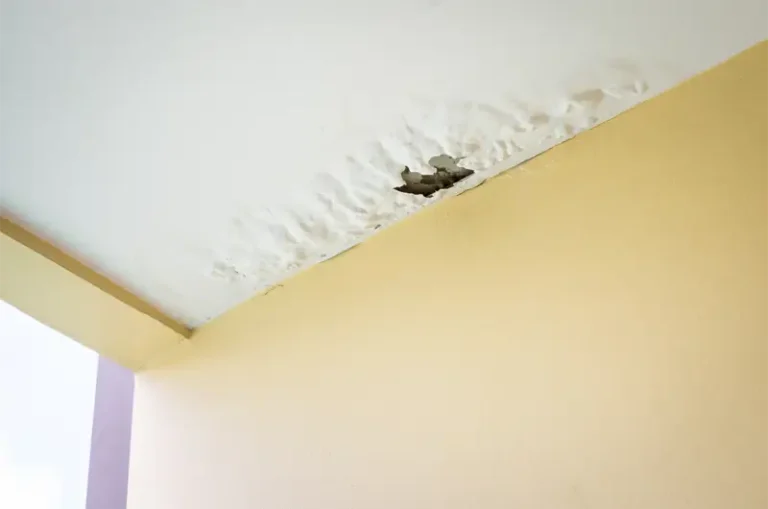
  • Peeling or bubbling paint — Moisture trapped behind interior wall and ceiling surfaces causes paint to lift, blister, or bubble. This is a sign the leak has likely been active for some time.
  • Warped or buckled drywall — Soft spots and deformation in ceiling or wall material indicate prolonged water contact, not a fresh or isolated event.
  • Rising energy bills — Water-saturated attic insulation loses its thermal resistance, forcing your HVAC system to work harder. Unexplained increases in heating or cooling costs can be an indirect indicator of a slow roof leak.
  • Mold or mildew on attic framing — Dark spotting or fuzzy growth on the underside of the roof deck or attic framing is a definitive sign of moisture intrusion. If you see this, contact us immediately, mold remediation becomes significantly more expensive the longer it spreads.

Our Roof Leak Detection Process for Utah Properties

Shep’s Roofing uses a systematic, multi-step detection process that moves from broad assessment to targeted isolation, locating leaks accurately regardless of how far water has traveled from its entry point.

  • Step 1: Interior Assessment — We begin where you noticed the problem. Stains, drips, peeling paint, warped drywall, and mold growth are documented by location and extent. We then trace the most probable water path upward through the building assembly, accounting for pipes, ducts, and structural members that may be channeling water laterally.
  • Step 2: Attic Inspection — The attic delivers the most valuable diagnostic information. We examine the underside of the roof sheathing for moisture trails, dark staining, active drips, and compressed or discolored insulation. In many cases, the attic inspection alone identifies the leak’s general origin point, significantly narrowing the exterior area we need to examine.
  • Step 3: Exterior Roof Inspection — We move to the roof surface with focused attention on the zones identified from inside. Every potential failure point is examined, flashing around chimneys, skylights, vent pipes, and dormers; shingle condition in valleys and at transitions; ridge and hip cap integrity; and the condition of pipe boots, vent collars, and satellite dish mounts. All damaged or improperly sealed components are photographed and documented.
  • Step 4: Controlled Water Testing — For leaks that cannot be identified visually, we apply water systematically to isolated roof sections, starting at the lowest suspect area and working upward, while a second technician monitors the interior for any sign of entry. This eliminates guesswork, confirms the exact penetration point, and is especially effective for intermittent leaks caused by wind-driven rain or ice dam conditions.
  • Step 5: Detailed Findings Report — Once the source is located, we provide a written report including photographs, a description of the failure mechanism, and a recommended roof repair plan with itemized pricing. No surprises, no pressure, just a clear explanation of the problem and the most cost-effective path to fixing it.

Why Choose Shep’s Roofing

  • Accurate Source Identification — We don’t guess. Our technicians use systematic inspection methods including attic moisture tracing and controlled water testing to pinpoint the exact point of entry, not just where water appears indoors.
  • Licensed & Local — Based in Helper, UT, we understand how Utah’s snow loads, freeze-thaw cycles, and hailstorms create the specific leak patterns common to this region.
  • Full Roof System Inspection — We examine every high-risk area, flashing transitions, valleys, pipe boots, ridge lines, and vent collars, not just the section you flagged.
  • Same-Day Emergency Response — Active leaks don’t wait for business hours. We offer 24/7 emergency availability with same-day or next-day dispatch for urgent situations.
  • Detection and Repair in One Visit — In most cases, we carry the materials needed to perform the repair immediately after locating the leak, minimizing disruption to your home.
  • Transparent Documentation — Every finding is photographed and documented in writing, useful for your records, warranty claims, and insurance adjuster meetings.
  • No Unnecessary Work — We recommend only what your roof actually needs. If the fix is minor, we will tell you, and price it accordingly.

Leak Detection for Every Roof Type

Our detection methods apply to every roofing system common in the Helper area. For asphalt shingle roofing, we focus on seal strip integrity, nail placement, flashing transitions, and valley conditions. For metal roofing systems, we inspect panel seam integrity, fastener condition, and expansion joint performance. Flat roof systems present unique challenges because water can pond and enter through pinholes or failed seams anywhere on the surface, we use systematic grid testing to isolate these entry points. Commercial roofing systems, which often feature TPO or EPDM membranes, require specialized knowledge of heat-welded seam behavior and membrane shrinkage patterns that our team is trained to evaluate.

Regardless of your roof type, the detection methodology is the same: systematic, evidence-based, and thorough. We do not guess, and we do not recommend repairs until we have confirmed the source.

What Happens After We Find the Leak

Once we identify the leak source, the next step depends on the nature and severity of the problem. Minor issues like a cracked pipe boot, a loose flashing section, or a handful of lifted shingles can often be repaired during the same visit. These targeted fixes are typically the most cost-effective roof repair category, ranging from $150 to $500 depending on the materials involved.

More complex leaks, those involving failed valley flashing, deteriorated underlayment, or multiple entry points, require a planned repair with material ordering and crew scheduling. We provide a written estimate that details every element of the repair, and we schedule the work at your convenience. For active leaks that cannot wait for a permanent fix, our emergency roofing team can deploy emergency tarping to prevent further water entry while the permanent repair is planned.

If our detection assessment reveals that the leak is a symptom of widespread roof deterioration, extensive underlayment breakdown, pervasive decking rot, or structural issues like sagging,  we will have an honest conversation about whether repair or roof replacement is the better investment. We never recommend replacement when a repair will solve the problem, and we never recommend patching a roof that needs replacement. Our goal is the right solution for your situation.

Testimonials

What They’re Saying About Us

***REVIEWS GO HERE***

Insurance and Roof Leak Claims in Utah

Homeowner’s insurance in Utah generally covers leak damage caused by sudden and accidental events, a tree branch puncturing the roof during a storm, hail cracking shingles, or wind ripping off ridge cap material. Damage caused by deferred maintenance, gradual wear, or neglect is typically excluded. This distinction is exactly why timely leak detection matters: a small leak caught early and traced to a storm event is far more likely to be covered than one that has been seeping for years.

Shep’s Roofing provides detailed documentation to support your insurance claim, including timestamped photographs, a written description of the damage and its cause, and an itemized repair estimate formatted to align with insurance industry standards. We are available to meet with your adjuster on-site to walk through our findings. Having professional documentation from a licensed contractor strengthens your claim and helps ensure fair processing.

Keep records of your regular roof inspections and any maintenance work performed. These records demonstrate to your insurer that the roof has been properly maintained, which supports your claim that the damage resulted from a covered event rather than neglect.

Proudly Serving Utah With Professional Roof Leak Detection Services

A hidden roof leak does not wait, and neither do we. Shep’s Roofing provides precise roof leak detection services from our home base in Helper, UT, extending across Carbon County and throughout the state. Our service areas include Salt Lake City, Provo, West Valley City, West Jordan, St. George, Lehi, Orem, Sandy, Eagle Mountain, Herriman, and Saratoga Springs. Explore our complete list of coverage zones on our Service Areas page. Whether you are dealing with an active drip, unexplained water stains, or a slow leak that has gone undetected for months, our experienced technicians locate the exact source and deliver a clear repair plan, fast.

Schedule Your Free Roof Leak Detection Assessment Today

A hidden leak does not get better on its own. Every day it goes undetected is a day that moisture is weakening your decking, degrading your insulation, and creating conditions for mold growth. Shep’s Roofing offers free, no-obligation leak detection assessments with a detailed findings report and written repair estimate. Our experienced technicians will locate the source, explain the cause, and give you a clear path to a permanent fix.

Call (435) 427-1552 or request your free estimate online to schedule your assessment. Same-day appointments are available for active leaks and emergency situations.

Frequently Asked Questions

How do I know if I have a roof leak or a plumbing leak?

Roof leaks and plumbing leaks can produce similar symptoms, ceiling stains, dripping water, and moisture damage. The key difference is timing: a roof leak typically worsens during or shortly after rain, while a plumbing leak is constant regardless of weather. Our technicians verify the source during every assessment to ensure the correct problem is addressed.

Yes. Intermittent leaks caused by wind-driven rain or ice dam conditions are among the most difficult to diagnose, but our controlled water testing method can reproduce the conditions that cause them. We systematically apply water to isolated sections of the roof to confirm the exact entry point, even when the leak cannot be triggered by a simple visual inspection.

Most residential assessments take one to three hours depending on the complexity of the roof and the nature of the leak. Simple single-point leaks can often be identified within an hour. Multi-source or intermittent leaks that require water testing may take longer. We take the time needed to get an accurate diagnosis rather than rushing to a guess.

In many cases, yes. Minor repairs like pipe boot replacement, sealant reapplication, and small flashing fixes can be completed during the detection visit. For more extensive repairs that require material ordering or additional crew, we schedule a follow-up at your convenience and can provide emergency tarping if needed in the meantime.

Shep’s Roofing offers complimentary leak detection assessments. If a repair is needed, we provide a written estimate with itemized pricing before any work begins. There is no obligation. Contact us or call (435) 427-1552 to schedule.

Insurance policies vary, but many Utah homeowner’s policies cover the cost of locating and repairing leak damage caused by a covered event such as a storm. We provide detailed documentation to support your claim. Visit our FAQ page for more information on insurance and roofing.

Our assessment includes verification of the leak source. If we determine the issue is a plumbing problem, condensation from HVAC equipment, or another non-roofing cause, we will let you know so you can contact the appropriate specialist. We do not charge for assessments that reveal a non-roofing issue.

Regular maintenance is the best prevention. Schedule professional roof inspections twice a year, keep gutters clear, trim overhanging branches, and address minor damage promptly. For Utah homeowners, ensuring proper attic insulation and ventilation is especially important to prevent ice dam formation during winter months. Browse our blog for additional maintenance tips and seasonal roofing advice.

Get in Touch with Us

Shep’s Roofing

435 N Main St, Helper, UT 84526

(435) 472-1552

Monday: 8AM – 8PM
Tuesday: 8AM – 8PM
Wednesday: 8AM – 8PM
Thursday: 8AM – 8PM
Friday: 8AM – 8PM
Saturday: 8AM – 8PM
Sunday: Closed

***MAP GOES HERE***

Quality roofing provider

Connect With Us

Shep’s Roofing
435 N Main St, Helper, UT 84526
(435) 472-1552
Mon–Sat: 8 AM – 8 PM