

Professional TPO Roofing Services

TPO Roofing Services

Thermoplastic Polyolefin, better known as TPO, has become the most widely installed single-ply commercial roofing membrane in the United States. For Utah building owners managing flat and low-slope commercial roofs through heavy snow loads, freeze-thaw cycling, and intense summer UV exposure, TPO delivers the combination of energy efficiency, seam strength, and long-term value that this climate demands.

Shep’s Roofing installs, repairs, and maintains TPO roofing systems for commercial properties throughout Utah, from our home base in Helper and Carbon County to the Wasatch Front, Utah Valley, and beyond. As part of our full commercial roofing services, TPO installation follows manufacturer specifications at every step, because your warranty depends on it and so does the long-term performance of your roof.

Whether you are building new, replacing an aging flat roof, or evaluating membrane options for an upcoming project, this page covers what you need to know about TPO roofing in the Utah market.

What Is TPO Roofing?

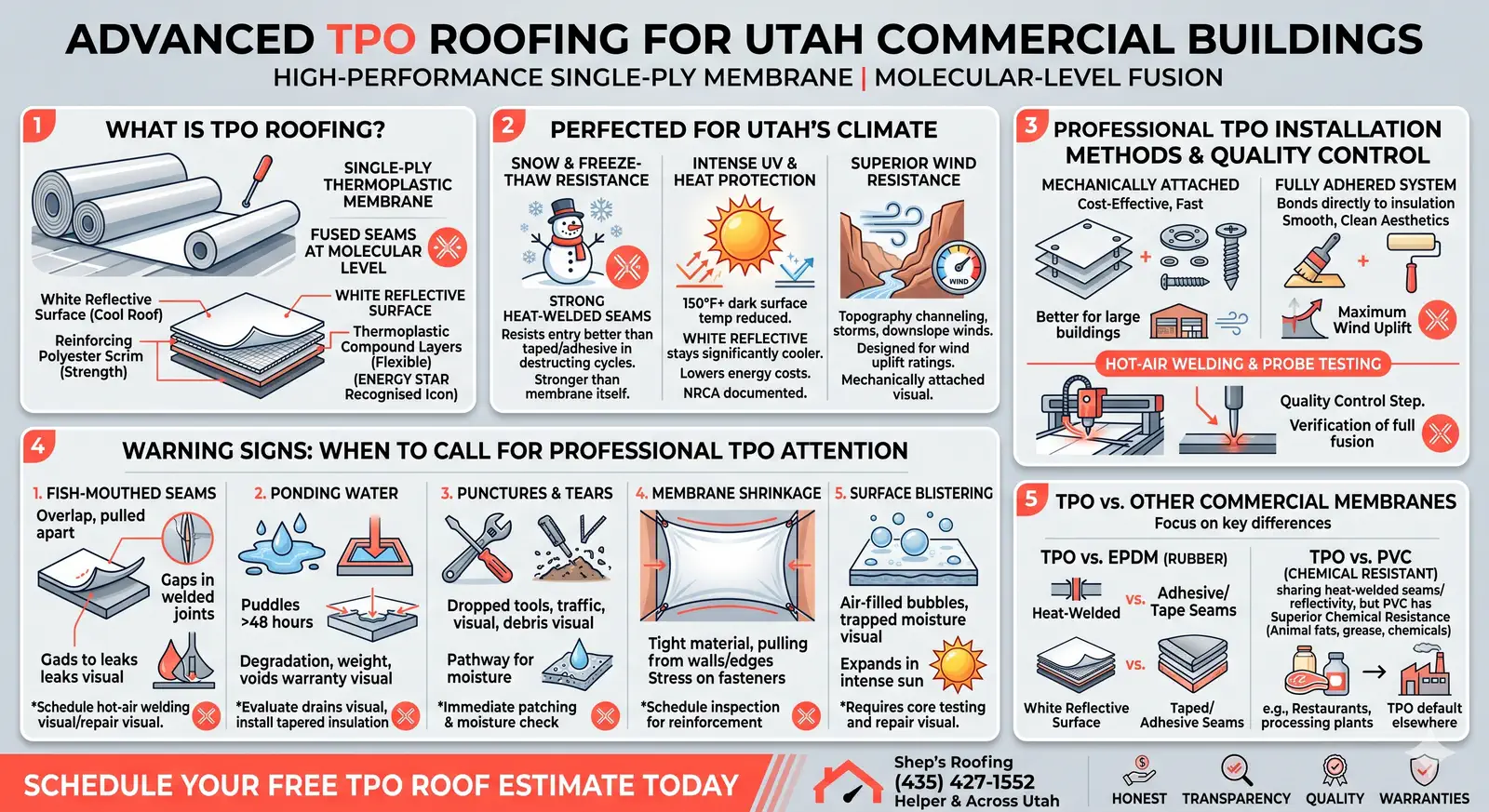
TPO is a single-ply thermoplastic membrane manufactured in large sheets (typically 6, 8, 10, or 12 feet wide) that are rolled out across a commercial roof deck, mechanically fastened or fully adhered to the insulation layer, and permanently bonded at every seam using a hot-air welding process. The result is a continuous, monolithic waterproofing surface with no adhesive-dependent joints, every seam is fused at the molecular level.

The membrane itself is a multi-layer product. A reinforcing polyester or fiberglass scrim sits between two layers of thermoplastic compound, giving the sheet both tensile strength and flexibility. TPO is available in 45-mil, 60-mil, and 80-mil thicknesses, with 60-mil being the most commonly specified for commercial installations seeking a balance between cost and long-term durability.

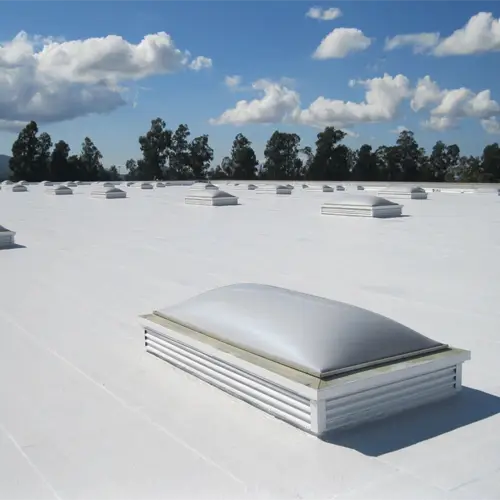
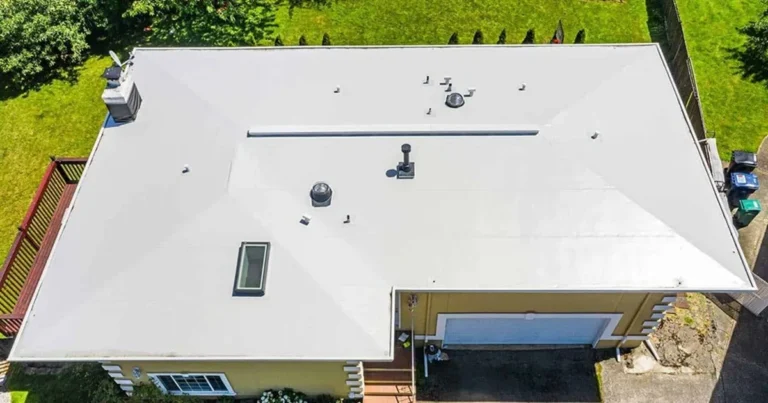
TPO’s white reflective surface is one of its defining features. By reflecting solar radiation rather than absorbing it, a TPO roof reduces rooftop surface temperatures significantly compared to dark-membrane alternatives like black EPDM. The U.S. Environmental Protection Agency’s ENERGY STAR program recognizes qualified TPO products for their contribution to building energy performance, a meaningful consideration for Utah building owners facing summer cooling loads that can drive energy costs well above national averages.

Why TPO Performs Well in Utah’s Climate

Utah’s climate creates specific challenges for commercial roofing systems, and TPO’s material properties align well with each of them.

Snow Load and Freeze-Thaw Resistance

Helper sits at roughly 5,800 feet of elevation in Carbon County, where winter brings consistent snowfall and temperatures that regularly cycle above and below freezing from November through March. This freeze-thaw pattern is one of the most destructive forces acting on any commercial roof membrane. Water enters microscopic openings, freezes and expands, then thaws and migrates deeper on the next cycle.

TPO’s heat-welded seams resist this mechanism far more effectively than adhesive-bonded or taped seam systems. A properly welded TPO seam is stronger than the membrane itself — pull-testing will cause the sheet to tear before the seam separates. That level of seam integrity means water cannot enter at the joints even under repeated thermal stress.

UV and Heat Exposure

Summer conditions along the Wasatch Front and in central Utah’s high desert push rooftop temperatures well above 150°F on dark surfaces. TPO’s reflective white surface stays significantly cooler, reducing thermal stress on the membrane and the building’s cooling systems simultaneously. The National Roofing Contractors Association (NRCA) has documented the energy performance benefits of reflective roofing membranes extensively, and TPO consistently ranks among the top-performing options for solar reflectance and thermal emittance.

Wind Resistance

Utah’s topography channels wind through valleys and canyons at velocities that can stress roofing systems, particularly during spring storm seasons and the downslope wind events that affect Carbon County and the Wasatch Front. TPO systems can be designed for FM Global wind uplift ratings appropriate to each building’s exposure category, and mechanically attached installations provide superior resistance to wind peeling compared to loose-laid ballasted systems.

TPO vs. Other Commercial Roofing Membranes

Building owners evaluating TPO often compare it against EPDM and PVC, the other two dominant single-ply membrane options. Each has distinct advantages depending on your building’s conditions.

TPO vs. EPDM

EPDM is a thermoset rubber membrane with a long performance history dating to the 1960s. It is valued for its flexibility, UV resistance, and competitive cost. However, EPDM seams are bonded with adhesive or seam tape rather than heat-welded, making them the most likely failure point over time, particularly in Utah’s freeze-thaw environment. EPDM is also available in black, which absorbs heat rather than reflecting it, though white EPDM options exist at a premium.

TPO’s heat-welded seams and inherent reflectivity give it an edge for new installations where energy performance and long-term seam reliability are priorities. EPDM remains a strong choice for budget-conscious reroofing projects and buildings where proven track record matters more than energy savings.

TPO vs. PVC

PVC membranes share TPO’s heat-welded seam technology and reflective surface properties. The primary differentiator is chemical resistance, PVC outperforms TPO in environments where animal fats, cooking grease, chemical exhaust, or petroleum-based substances contact the roof surface. Restaurants, food processing plants, and manufacturing facilities with chemical exposure typically specify PVC for this reason.

For standard commercial applications without chemical exposure, offices, retail, warehouses, schools, TPO delivers comparable waterproofing performance at a lower installed cost. This makes TPO the default specification for the majority of commercial buildings Shep’s Roofing works on across Utah.

When Your TPO Roof Needs Professional Attention in Utah

Catching flat roof issues early can save your business thousands of dollars in structural water damage and premature replacement costs. Use this quick reference guide to identify the common warning signs that your Utah commercial building requires expert TPO roof repair.

Warning Sign

What It Looks Like

Why It Matters

Recommended Action

“Fish-Mouthed” Seams

Gaps or openings where the overlapped, heat-welded membrane edges have pulled apart.

Allows snowmelt and rain to completely bypass the waterproof barrier, leading to immediate leaks.

Schedule a professional hot-air welding repair to reseal the joint.

Ponding Water

Puddles of standing water that remain on the roof for more than 48 hours after precipitation.

Accelerates membrane degradation, adds extreme dead weight, and often voids manufacturer warranties.

Have a professional evaluate your roof drains and install tapered insulation.

Punctures and Tears

Visible holes or deep scuffs from dropped HVAC tools, heavy foot traffic, or windblown debris.

Creates a direct pathway for moisture to saturate the underlying polyiso insulation and enter the building.

Request immediate membrane patching and a moisture intrusion check.

Membrane Shrinkage

The white TPO material appears stretched tight and is visibly pulling away from parapet walls or edges.

Places extreme stress on mechanical fasteners and creates wide-open entry points for wind-driven rain.

Schedule an inspection for perimeter flashing reinforcement.

Surface Blistering

Raised, air-filled bubbles or pockets forming under the flat surface of the TPO membrane.

Indicates that moisture is trapped beneath the system and is expanding under the intense Utah sun.

Requires core testing and targeted repair to remove the trapped moisture.

Our TPO Installation Methods

Shep’s Roofing installs TPO using two primary attachment methods, each selected based on the building’s structural deck type, wind uplift requirements, and insulation design.

Mechanically Attached TPO

In a mechanically attached system, the TPO membrane is fastened to the roof deck through the insulation layer using specialized plates and screws at calculated spacing. The membrane sheets overlap at each fastener row, and the hot-air welding process seals the top sheet to the bottom sheet, encapsulating the fasteners beneath a watertight seam. This method is cost-effective, installs quickly on large-area roofs, and provides strong wind uplift performance.

Mechanically attached TPO is the most common installation method for warehouses, distribution centers, and large commercial buildings across Utah where structural steel or concrete decks provide reliable fastener pull-out resistance.

Fully Adhered TPO

Fully adhered systems bond the TPO membrane directly to the insulation or cover board using a low-VOC adhesive applied to both surfaces. Once positioned and rolled into the adhesive, the membrane lies flat with no mechanical fasteners penetrating the waterproofing layer. Seams are still heat-welded.

Fully adhered installations are preferred for buildings where aesthetics matter (the surface lies perfectly smooth), where the deck type does not support mechanical fasteners reliably, or where the building owner wants maximum wind uplift resistance. The installed cost is higher than mechanically attached systems, but the result is a cleaner-looking roof with no fastener-related stress points.

The Heat-Welding Process

Regardless of attachment method, every TPO seam is welded using an automated hot-air welding machine that applies controlled heat and pressure as it travels along the membrane overlap. The machine fuses the two membrane layers into a permanent bond that, when executed correctly, exceeds the tensile strength of the membrane sheet itself.

Our crews probe-test every welded seam on every project. A blunt probe is drawn along the full length of the seam edge to verify complete fusion, any unbonded section is re-welded and re-tested before the project moves forward. This is a non-negotiable quality control step that directly protects your warranty and your building.

Why Choose Shep’s Roofing

  • Expert Seam Welding: A TPO roof is only as reliable as its seams. Our technicians are rigorously trained to calibrate their hot-air welding equipment for Utah’s specific daily temperatures and humidity levels, guaranteeing a flawless, monolithic waterproof bond.
  • Tailored Membrane Solutions: We do not push a generic product on our clients. We help you select the exact 45-mil, 60-mil, or 80-mil TPO thickness required based on your rooftop foot traffic, mechanical loads, and long-term warranty goals.
  • Advanced Drainage Engineering: Flat roofs are highly susceptible to standing water after heavy mountain snowmelt. We expertly design and install tapered polyiso insulation systems beneath your new TPO membrane to ensure positive drainage and prevent voided warranties.
  • Energy Efficiency Focus: We maximize your return on investment by properly installing highly reflective white TPO systems. This proven cool roof technology drastically reduces heat absorption and lowers your summer cooling costs.
  • Strict Site Safety: We maintain organized, OSHA-compliant job sites to keep your employees, tenants, and customers completely safe while our commercial crews work efficiently overhead.

TPO Roofing and Energy Efficiency

Energy performance is one of the most compelling reasons building owners in Utah choose TPO. A reflective TPO membrane can reduce rooftop surface temperatures by 50°F or more compared to a dark-surface roof on a summer afternoon. That temperature reduction translates directly to lower cooling energy consumption, a benefit that compounds every year across the roof’s 20-to-30-year service life.

For buildings pursuing energy code compliance or voluntary sustainability certifications, TPO’s solar reflectance index (SRI) values meet or exceed the thresholds required by the International Energy Conservation Code (IECC) and programs like LEED and ENERGY STAR. Utah’s adoption of energy code standards means that new commercial construction and major reroofing projects must meet minimum roof reflectance requirements in many jurisdictions, and TPO satisfies these requirements without additional coatings or treatments.

Pairing a reflective TPO membrane with upgraded polyisocyanurate insulation during installation maximizes the energy investment. Shep’s Roofing designs insulation layups that meet or exceed current code R-value requirements while using tapered insulation boards to create positive drainage slope, eliminating ponding water and improving membrane longevity at the same time.

TPO Roofing and Storm Damage in Utah

Utah’s spring and summer storm seasons bring hail, high winds, and driving rain that can damage commercial roofing systems. TPO membranes offer good impact resistance, but large hail can puncture or crack the membrane surface,  particularly on older systems where UV exposure has reduced the material’s flexibility.

If your commercial building sustains storm damage, Shep’s Roofing provides storm damage roofing assessments that document the extent of membrane damage for insurance claims. We photograph every impact point, measure affected areas, and prepare scope documentation that your insurance adjuster needs to process the claim. For buildings requiring immediate protection, our emergency roofing team can deploy temporary weatherproofing to prevent interior damage while the permanent repair or replacement is scheduled.

Hail damage on TPO roofs is not always visible from inside the building immediately after the event. The membrane may be bruised or cracked without producing an active leak right away, but the compromised areas will fail during subsequent weather events. A post-storm roof inspection is essential to identify damage before it escalates.

Testimonials

What They’re Saying About Us

***REVIEWS GO HERE***

Proudly Serving Utah With Expert TPO Roofing Services 

Upgrading your commercial facility with a durable, energy-efficient flat roof requires a local contractor who understands Utah’s unique climate demands. Shep’s Roofing proudly provides expert TPO roofing installations, heat-welded seam repairs, and complete commercial membrane replacements to businesses across the state.

Our service areas include Helper, Salt Lake City, Provo, West Valley City, West Jordan, St. George, Lehi, Orem, Sandy, Eagle Mountain, Herriman, and Saratoga Springs. Explore our complete list of coverage zones on our Service Areas page. Whether you need a highly reflective cool roof to lower summer cooling costs or a robust system engineered to handle heavy winter snow loads, our dedicated crews are ready to protect your investment

Schedule Your Free TPO Roofing Estimate in Utah Today

If you are considering TPO for a new commercial roof, need repairs on an existing TPO system, or want a professional assessment of your current flat roof condition, Shep’s Roofing is ready to help. We provide honest recommendations, detailed proposals, and installation quality backed by manufacturer warranties.

Call (435) 427-1552 or visit our contact page to get started with a free roof estimate.

Frequently Asked Questions

How long does a TPO roof last in Utah?

A properly installed and maintained TPO roof typically delivers 20 to 30 years of service life. Membrane thickness, installation quality, UV exposure, and maintenance frequency all influence actual longevity. In Utah’s climate, the combination of UV intensity and freeze-thaw cycling makes regular inspections and timely repairs essential to reaching the upper end of that range.

Installed TPO roofing costs in Utah generally range from $5.50 to $8.50 per square foot, depending on membrane thickness, attachment method, insulation requirements, tear-off scope, and warranty level. Shep’s Roofing provides free estimates with itemized pricing so you can evaluate options with full transparency.

TPO and EPDM each have strengths. TPO offers heat-welded seams and superior energy reflectivity. EPDM offers proven long-term flexibility and lower material cost. For new construction in Utah where energy codes require reflective roofing, TPO is typically the better fit. For budget reroofing where the existing insulation will be retained, EPDM remains competitive.

Yes. Localized damage, punctures, seam deficiencies, flashing failures, can be repaired with heat-welded TPO patches and detailed work. If the membrane is widely degraded, a roof coating system may extend service life by 10 to 15 years. When damage is extensive or the insulation is saturated, full replacement becomes the most cost-effective solution.

Many TPO products from major manufacturers meet ENERGY STAR requirements for reflective roofing. Check the EPA’s ENERGY STAR roof products listing for specific product certifications. TPO also satisfies the roof reflectance requirements in the International Energy Conservation Code (IECC) adopted across most Utah jurisdictions.

TPO membranes are designed for structural loading, the snow load itself is carried by the roof deck and structural framing, not the membrane. However, TPO’s heat-welded seams prevent snowmelt water from infiltrating at joints during the freeze-thaw cycles that are common throughout Utah winters, making it a strong performer in heavy-snow climates.

Get in Touch with Us

Shep’s Roofing

435 N Main St, Helper, UT 84526

(435) 472-1552

Monday: 8AM – 8PM
Tuesday: 8AM – 8PM
Wednesday: 8AM – 8PM
Thursday: 8AM – 8PM
Friday: 8AM – 8PM
Saturday: 8AM – 8PM
Sunday: Closed

***MAP GOES HERE***

Quality roofing provider

Connect With Us

Shep’s Roofing
435 N Main St, Helper, UT 84526
(435) 472-1552
Mon–Sat: 8 AM – 8 PM