



Commercial Roofing Services

Commercial Roofing Services - Shep's Roofing

Your commercial property represents one of the largest investments your business will ever make, and the roof protecting it needs to perform through every season Utah throws at it. From heavy spring snow loads along the Wasatch Front to intense summer UV exposure in Carbon County and beyond, commercial roofing demands materials, installation methods, and ongoing maintenance strategies that go far beyond what residential roofs require.

Shep’s Roofing delivers full-service commercial roofing solutions for business owners, property managers, and facility directors throughout Utah. Whether you operate a warehouse in Helper, a retail center in Salt Lake City, or an office complex in Provo, our licensed and insured crews specialize in the roofing systems that protect commercial structures: TPO single-ply membranes, elastomeric roof coatings, flat roof assemblies, standing seam metal, modified bitumen, and EPDM rubber roofing.

We handle every phase of the commercial roofing lifecycle, from initial roof inspections and leak diagnostics through full-scale roof replacement and preventive maintenance programs. Every project starts with a free roof estimate and an honest assessment of what your building actually needs.

What Makes Commercial Roofing Different from Residential Roofing

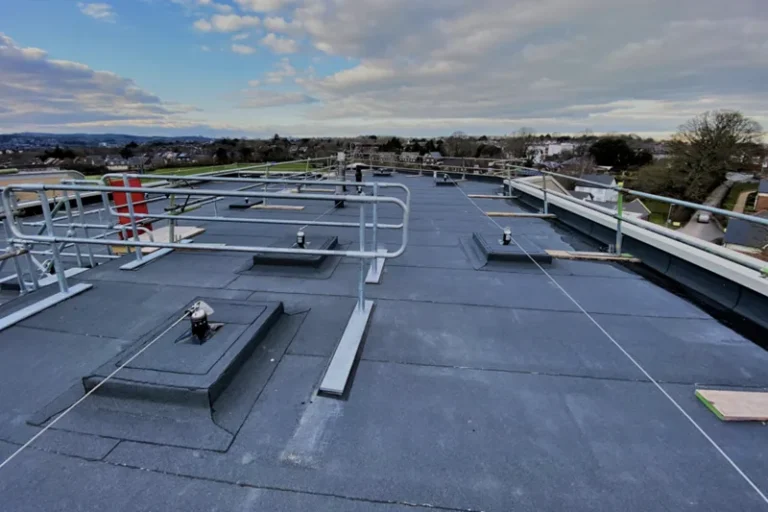
Commercial and residential roofing share a common goal, keeping water out, but the similarities end there. Commercial buildings typically feature low-slope or flat roof designs that require entirely different materials, drainage engineering, and installation techniques compared to the steep-slope shingle systems found on most homes.

A commercial roof must also support significantly more mechanical load. Rooftop HVAC units, exhaust fans, satellite equipment, solar arrays, and foot traffic from maintenance personnel all place demands that residential roofs never face. The membrane or surface material needs to resist puncture, UV degradation, pooling water, and thermal cycling without failing at seams or penetration points.

Building code requirements differ as well. Utah’s adoption of the International Building Code (IBC) imposes specific wind uplift ratings, fire classification standards, and insulation R-values for commercial structures that exceed residential minimums. The International Code Council publishes these standards, and any commercial roofing contractor working on your building should demonstrate familiarity with the current code cycle.

Shep’s Roofing understands these differences because commercial work is a core part of what we do, not a sideline. Our crews carry manufacturer certifications for the systems we install, and our project managers coordinate directly with building inspectors to ensure every job meets or exceeds code.

Types of Commercial Roofing Systems We Install in Utah

Choosing the right roofing system for your commercial building depends on several factors: roof slope, building use, energy performance goals, budget, and expected service life. Below is an overview of the primary systems Shep’s Roofing installs and maintains across Utah.

TPO Roofing

Thermoplastic Polyolefin (TPO) has become the most widely specified single-ply commercial roofing membrane in the United States, and for good reason. TPO delivers strong reflectivity, heat-welded seam integrity, and competitive installed costs that make it a practical choice for a wide range of commercial applications.

Our TPO roofing crews install fully adhered and mechanically attached TPO systems in 45-mil, 60-mil, and 80-mil thicknesses depending on building requirements and warranty targets. The heat-welded seams that define TPO installation create a monolithic bond that outperforms adhesive-based seaming methods in long-term weathertightness testing. For Utah buildings facing freeze-thaw cycling and heavy snow, that seam strength matters.

TPO’s white reflective surface also contributes to measurable energy savings by reducing rooftop heat absorption, a benefit the U.S. Environmental Protection Agency’s ENERGY STAR program recognizes through its qualified roof products listing. If your building’s cooling costs spike every summer, TPO is worth evaluating.

EPDM Rubber Roofing

Ethylene Propylene Diene Monomer (EPDM) is the legacy workhorse of commercial flat roofing. This synthetic rubber membrane has been in continuous use on commercial buildings since the 1960s and maintains a proven track record for durability, flexibility, and resistance to UV radiation and ozone exposure.

EPDM systems are available in black or white and can be installed as fully adhered, mechanically attached, or ballasted assemblies. The material’s natural elasticity allows it to accommodate building movement and thermal expansion without cracking, a practical advantage in Utah’s climate where rooftop temperatures can swing 80°F or more between winter lows and summer highs.

PVC Roofing

Polyvinyl Chloride (PVC) membranes share TPO’s heat-welded seam technology but offer superior chemical resistance, making PVC the preferred choice for restaurants, food processing facilities, and any building where rooftop grease exhaust or chemical fumes contact the roof surface. PVC also provides inherent fire resistance and strong reflectivity.

Modified Bitumen

Modified bitumen systems combine the proven waterproofing performance of asphalt with polymer modifiers, either APP (atactic polypropylene) or SBS (styrene-butadiene-styrene), that improve flexibility, UV resistance, and cold-weather performance. These multi-ply systems are torch-applied, cold-adhered, or self-adhered and provide redundant waterproofing layers that many building owners prefer for long-term reliability.

Standing Seam Metal Roofing

For commercial buildings with sufficient slope, standing seam metal roofing delivers exceptional longevity, wind resistance, and aesthetic versatility. Metal panel systems can span 40 to 60 years with proper maintenance and are available in steel, aluminum, and zinc substrates with factory-applied finishes rated for color and chalk retention.

Metal roofing also performs well under Utah’s snow loads. The smooth panel surface encourages controlled snow shedding, and the concealed fastener design of standing seam systems eliminates the exposed penetration points that cause leaks on screw-down metal roofs over time.

Built-Up Roofing (BUR)

Built-up roofing, often called “tar and gravel” roofing,  is the oldest modern commercial roofing system. BUR assemblies consist of alternating layers of bitumen and reinforcing fabrics topped with a gravel or mineral cap surface. While newer single-ply systems have captured market share, BUR remains a viable choice for buildings requiring heavy foot traffic resistance and proven multi-decade performance.

Commercial Roofing System Comparison

Understanding how each roofing system stacks up across the factors that matter most helps building owners make informed decisions. The table below compares the primary commercial roofing systems Shep’s Roofing installs based on typical performance benchmarks observed across Utah installations.

Roofing System

Expected Lifespan

Estimated Cost (per sq ft)

Energy Efficiency

Best For

TPO Single-Ply

20–30 years

$5.50–$8.50

High (reflective white surface)

Warehouses, retail, offices seeking energy savings

EPDM Rubber

25–30 years

$5.00–$8.00

Moderate (white) to Low (black)

Budget-conscious owners, buildings with heavy thermal movement

PVC Membrane

20–30 years

$6.50–$10.00

High (reflective, chemical-resistant)

Restaurants, food processing, chemical exposure environments

Modified Bitumen

20–25 years

$5.00–$9.00

Moderate

Multi-ply redundancy, heavy foot traffic areas

Standing Seam Metal

40–60 years

$10.00–$16.00

High (cool-coat finishes available)

Long-term ownership, sloped commercial, aesthetic priority

Built-Up (BUR)

20–30 years

$5.50–$9.50

Low to Moderate

Heavy foot traffic, proven long-term waterproofing

Cost ranges reflect typical installed pricing in the Utah market including materials, labor, and standard insulation. Actual project costs vary based on roof size, access conditions, deck type, insulation requirements, and warranty level selected.
Commercial Roofing Coatings and Restoration

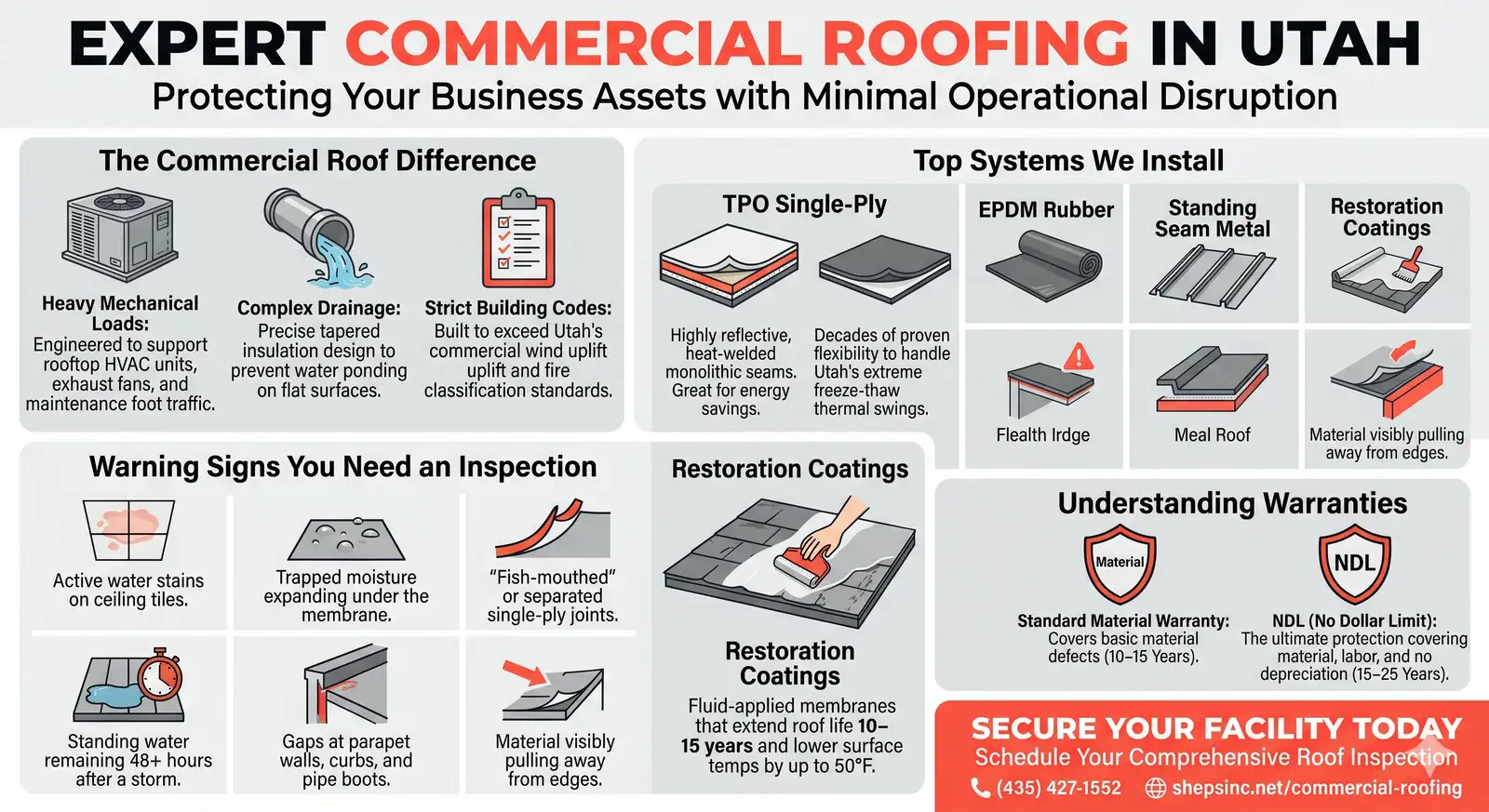
Not every aging commercial roof needs a full tear-off and replacement. In many cases, a professionally applied commercial roofing coating system can extend the functional life of an existing roof by 10 to 15 years at a fraction of the cost of re-roofing, while improving energy performance and eliminating active leaks.

Roof coatings are fluid-applied membranes that cure into a seamless, monolithic barrier over the existing roof surface. Shep’s Roofing applies silicone, acrylic, and polyurethane coating systems depending on the substrate, slope, and ponding water conditions present on each building.

When Coating Makes Sense

Coating restoration works best when the existing roof structure and insulation remain sound but the surface membrane has degraded. Common candidates include aged single-ply roofs with intact seams but UV-worn surfaces, metal roofs with surface corrosion or failing fastener seals, and modified bitumen roofs approaching the end of their initial service life.

A thorough roof inspection determines whether coating is viable. If the existing insulation is saturated or the deck has structural damage, coating alone will not solve the problem, and we will tell you that upfront rather than sell a solution that will not perform.

Energy and Cost Benefits

A reflective roof coating can reduce rooftop surface temperatures by up to 50°F during peak summer conditions, translating directly to lower cooling energy consumption. The National Roofing Contractors Association (NRCA) recognizes coating and restoration as a legitimate lifecycle management strategy for commercial roofs, and many building owners use coating cycles to defer full replacement for years while maintaining warranty protection.

Why Choose Shep’s Roofing

  • Honest and Transparent Planning: We do exactly what we say we will do. You can count on straightforward estimates and realistic timelines that allow you to plan your daily operations without unexpected disruptions.
  • Highly Trained Local Crews: Our roofing professionals show up on time, fully equipped, and trained to handle the specific complexities of large-scale commercial installations and repairs.
  • Minimal Operational Disruption: We coordinate closely with property managers and facility teams to ensure our roofing work doesn’t interrupt your business operations, prioritizing the safety of your employees and customers at all times.
  • Comprehensive Maintenance Programs: Beyond installation and repair, we offer proactive maintenance plans designed to extend the lifespan of your commercial roof, catch minor issues before they become major leaks, and protect your capital investment.
  • Manufacturer Certifications: We hold the necessary industry credentials to properly install premium flat roofing systems and issue the comprehensive, long-term manufacturer warranties your business needs.
  • Proven Accountability: We stand firmly behind our workmanship long after the final inspection is complete. We are not a fly-by-night company; we are rooted right here in Utah.

Flat Roof Systems: Design, Installation, and Maintenance

Flat and low-slope roofs account for the majority of commercial roofing square footage in the United States, and Utah is no exception. Managing water on a flat surface, where gravity provides minimal drainage assistance, requires precise engineering of slopes, drains, scuppers, and membrane systems that most residential roofers never encounter.

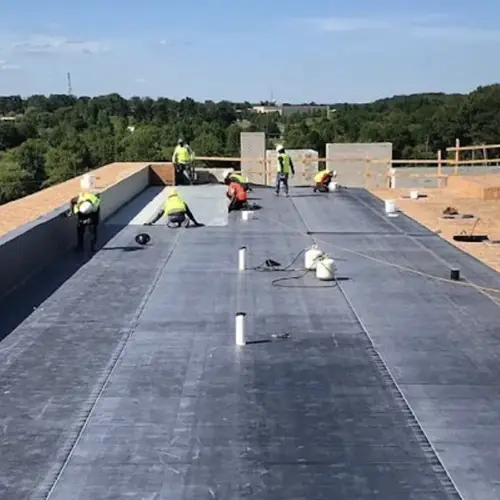
Shep’s Roofing designs and installs complete flat roof systems including the structural deck preparation, vapor retarder installation, insulation layup, membrane application, and flashing details that together form a watertight assembly. We work with tapered insulation systems to create positive drainage slopes on roofs that were originally built dead-flat, eliminating the ponding water conditions that accelerate membrane failure and void manufacturer warranties.

Common Flat Roof Problems in Utah

Utah’s climate creates specific challenges for flat commercial roofs. Heavy snow accumulation during winter months adds significant dead load, and the freeze-thaw cycling that occurs as daytime temperatures rise above freezing while nighttime temperatures drop well below it stresses membrane seams and flashing terminations repeatedly throughout the season.

Ponding water is another persistent issue. After snowmelt or rain events, any area of a flat roof that holds water for more than 48 hours is considered to have a ponding condition, and most single-ply membrane warranties exclude damage caused by ponding. Proper drainage design during installation, or corrective tapered insulation retrofits on existing roofs, prevents this problem.

If your flat roof is showing signs of distress, active leaks, blistering, membrane shrinkage, or open seams, our roof leak detection services can pinpoint the source without destructive investigation. From there, targeted roof repairs or a planned replacement can be scoped accurately.

Commercial Roof Warranty Comparison

Warranty protection is one of the most important, and most misunderstood, factors in a commercial roofing investment. The table below outlines the typical warranty structures available for major commercial roofing systems to help you evaluate coverage options.

Warranty Type

Coverage Period

What It Covers

What It Excludes

Key Considerations

Manufacturer Standard Material

10–15 years

Defects in membrane material

Labor, consequential damage, ponding water, Acts of God

Lowest cost; limited real-world protection

Manufacturer NDL (No Dollar Limit)

15–25 years

Material and labor for covered defects, no depreciation

Ponding water (usually), foot traffic damage, owner modifications

Requires certified installer; periodic inspections often mandatory

Contractor Workmanship

2–10 years

Installation defects, flashing failures, seam issues

Material defects (covered by manufacturer), owner-caused damage

Only as reliable as the contractor’s financial stability

Extended System Warranty

20–30 years

Full system including material, labor, and consequential damage

Varies by manufacturer; read exclusions carefully

Premium cost but strongest protection; typically requires maintenance contract

Testimonials

What They’re Saying About Us

***REVIEWS GO HERE***

Signs Your Commercial Roof Needs Attention in Utah

Commercial roof problems rarely announce themselves dramatically. More often, damage accumulates gradually until a catastrophic failure, usually during the worst possible weather, forces an emergency response that costs far more than planned maintenance would have.

Watch for these warning signs across your commercial roof:

  • Interior leaks and ceiling stains: Active leaks or water stains on ceiling tiles are the most obvious indicators. By the time water reaches the interior, the membrane breach and insulation saturation may already be extensive.
  • Blistering, ridging, or bubbling: These surface deformities on the membrane strongly suggest that moisture is trapped beneath the roofing system.
  • Open or fish-mouthed seams: On single-ply roofs, separated or lifted seams expose the building to water infiltration during every single rain event.
  • Ponding water: Water that remains pooled on the roof for more than 48 hours after precipitation indicates a serious drainage failure.
  • Flashing separations: Gaps or separations where the roof meets walls, curbs, and penetrations create easy entry points for wind-driven rain.
  • Visible membrane shrinkage: Roofing material that is pulling away from the edges or penetrations is a clear signal of severe material fatigue.

If you are seeing any of these conditions, schedule an inspection before a minor issue becomes a major expense. Shep’s Roofing provides thorough commercial roof inspections with documented findings and prioritized repair recommendations.

Proudly Serving Utah With Professional Commercial Roofing Services

Protecting your business assets starts with a reliable, high-performance roof engineered for your specific environment. Shep’s Roofing proudly provides comprehensive commercial roofing installations, preventative maintenance, and flat roof repairs to businesses, industrial facilities, and property managers across Utah. Our service areas include Helper, Salt Lake City, Provo, West Valley City, West Jordan, St. George, Lehi, Orem, Sandy, Eagle Mountain, Herriman, and Saratoga Springs. Explore our complete list of coverage zones on our Service Areas page. From energy-efficient TPO membranes to emergency leak repairs that minimize operational downtime, our experienced local crews are dedicated to keeping your enterprise secure and fully operational year-round. 

Get a Free Commercial Roofing Estimate in Utah Today

Whether you need a full commercial roof replacement, a coating restoration, or just a professional inspection to understand your roof’s current condition, Shep’s Roofing is ready to help. We serve commercial building owners throughout Utah with honest assessments, transparent pricing, and installation quality backed by manufacturer warranties.

Call us today at (435) 427-1552 or visit our contact page to schedule your free roof estimate.

Frequently Asked Questions

How long does a commercial roof last in Utah?

Most commercial roofing systems deliver 20 to 30 years of service life when properly installed and maintained. Standing seam metal systems can exceed 40 years. The actual lifespan depends on the system selected, installation quality, maintenance frequency, and local climate exposure. Utah’s UV intensity and freeze-thaw cycling are among the primary factors that affect membrane longevity in this market.

Installed costs for commercial roofing in Utah typically range from $5.00 to $16.00 per square foot depending on the system type, insulation requirements, tear-off scope, and warranty level. TPO and EPDM systems fall on the lower end, while standing seam metal and high-specification PVC systems command premium pricing. Shep’s Roofing provides free itemized estimates so you can compare options with full cost transparency.

TPO is a thermoplastic membrane that is heat-welded at seams and provides strong reflectivity for energy savings. EPDM is a thermoset rubber membrane that is adhered or taped at seams and is valued for flexibility, UV resistance, and a long performance history. TPO is generally preferred for new construction where energy codes favor reflective surfaces, while EPDM remains popular for reroofing projects and budget-conscious applications. Our TPO roofing page covers this system in detail.

Yes, if the existing roof structure, insulation, and membrane substrate are in sound condition, a professionally applied roof coating system can extend service life by 10 to 15 years at significantly lower cost than full replacement. A roof inspection is required to determine whether coating is a viable option for your specific building.

Industry best practice recommends professional inspections twice per year, once in spring after winter weather and once in fall before the snow season. Additional inspections should follow any significant weather event, especially hail or high-wind storms. Regular inspections catch small problems before they become expensive failures.

Storm-related damage to commercial roofs is generally covered under commercial property insurance policies, subject to your deductible and policy terms. Damage caused by normal wear and aging is typically excluded. Shep’s Roofing works with commercial property owners and their insurance adjusters to document storm damage scope and support the claims process.

There is no single “best” system, the right choice depends on your building’s specific conditions. TPO and PVC are excellent for buildings prioritizing energy efficiency. EPDM offers reliable performance at competitive cost. Modified bitumen provides multi-ply redundancy for heavy-traffic roofs. Our flat roof systems page explains the options in detail, and our inspection process helps identify which system matches your building’s needs.

Get in Touch with Us

Shep’s Roofing

435 N Main St, Helper, UT 84526

(435) 472-1552

Monday: 8AM – 8PM
Tuesday: 8AM – 8PM
Wednesday: 8AM – 8PM
Thursday: 8AM – 8PM
Friday: 8AM – 8PM
Saturday: 8AM – 8PM
Sunday: Closed

***MAP GOES HERE***

Quality roofing provider

Connect With Us

Shep’s Roofing
435 N Main St, Helper, UT 84526
(435) 472-1552
Mon–Sat: 8 AM – 8 PM